Online Reporter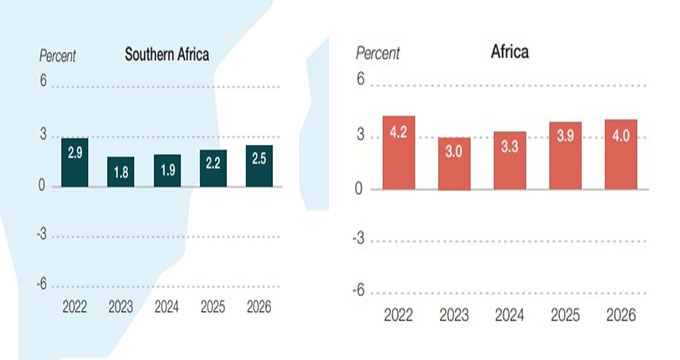
Nqobile Bhebhe, Zimpapers Business Hub
Zimbabwe is among a select group of Southern African countries projected to register strong economic growth of six percent or more in 2025, defying the region’s generally subdued economic outlook, according to the African Development Bank’s latest report.
In its 2025 African Economic Outlook (AEO), released during the bank’s annual meetings currently underway in Abidjan, Côte d’Ivoire, the AfDB said that while Southern Africa’s economic performance remains weak, Zimbabwe, Zambia and eSwatini are expected to post robust growth rates in the year ahead.
“Despite the low regional growth outlook, few countries (eSwatini, Zambia, and Zimbabwe) are projected to grow by six percent or higher in 2025,” reads part of the report.
The report further notes that tariff uncertainty is expected to have the most pronounced impact in Botswana and Lesotho over the forecast period.
“Tariff uncertainty will have the largest growth impact in Botswana and Lesotho over the two-year forecast period.”
The region’s overall growth is estimated at 1.9 percent in 2024, with projections indicating a moderate rise to 2.2 percent in 2025, and 2.5 percent in 2026.
However, these forecasts represent downward revisions of 0.9 and 0.6 percentage points, respectively, from earlier estimates published in the February 2025 Macroeconomic Performance and Outlook (MEO).
On the broader continental front, the Bank reported that Africa’s economic performance showed signs of improvement in 2024, but warned that growth remains fragile, as the continent continues to grapple with a combination of multiple shocks and heightened global uncertainty.
“Across the continent, growth in real gross domestic product (GDP) picked up marginally from 3.0 percent in 2023 to 3.3 percent in 2024, buoyed by strong government spending and private consumption. The growth uptick in 2024 was evident in 29 of 54 African countries,” the bank noted.
It added, “Africa’s growth is now projected to accelerate from 3.3 percent in 2024 to 3.9 percent in 2025, firming up further to 4.0 percent in 2026, but these projections represent downgrades of 0.2 and 0.4 percentage points from the 2025 MEO.”
The Bank attributes the downgrade primarily to subdued global economic activity, which is likely to dampen demand for African exports.
“The downward revision to Africa’s real GDP growth outlook is largely due to the impact of subdued global economic activity, which is expected to affect African exports,” the report said.
The 2025 report was compiled in a context marked by significant changes in the global economic landscape.
For instance, major shifts in trade policy by key global economies in April 2025 have led to heightened uncertainty and disruption in international markets.
At the same time, the AfDB noted, several development partners have announced substantial cuts in aid budgets, mainly due to shifting domestic policy priorities in donor countries.
“This action will undoubtedly create a funding squeeze for low-income countries, especially those in Africa, that heavily depend on international development assistance,” the Bank said.
However, the Bank expressed optimism regarding the resilience of several African economies.
“Yet, even after accounting for these factors, projected growth in 21 countries is expected to exceed 5 percent in 2025. This resilience is forged by hard-won gains from effective domestic reforms, relative diversification, and improved macroeconomic management over the past decade.”
Zimbabwe’s projected strong performance is in line with Government’s ongoing efforts to implement far-reaching economic reforms under the National Development Strategy 1 (NDS1), which seeks to attain Vision 2030, an upper middle-income economy.