admin
admin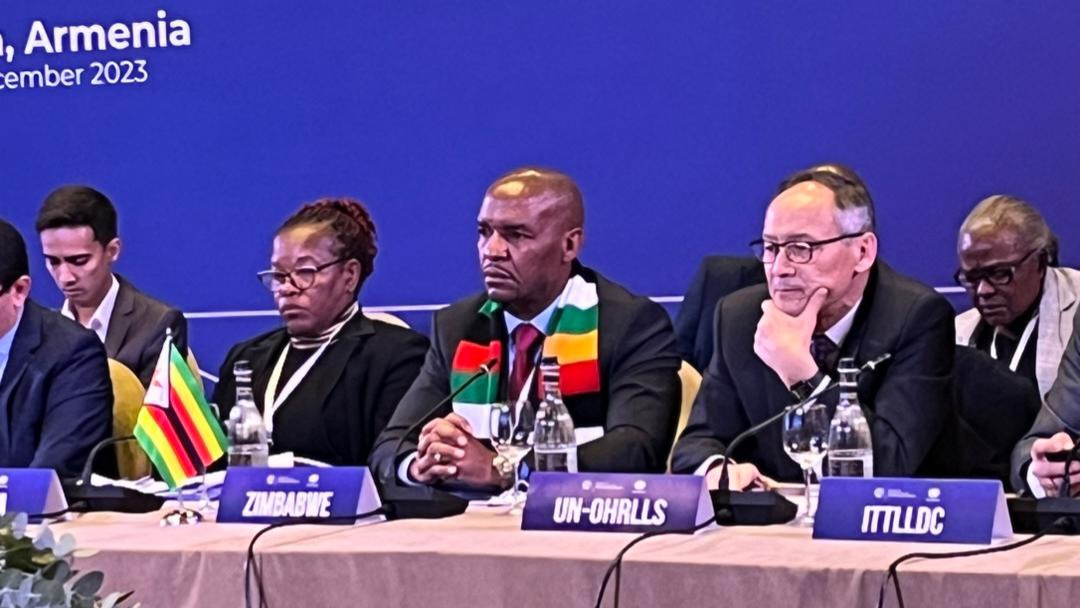
Freeman Razemba
Senior Reporter
Zimbabwe has prioritised infrastructural development by committing local resources towards the completion of a 580km world-class highway along the North-South corridor which links to the modernised Beitbridge Border Post, which has been completed in the first quarter of this year, Government has said.Zimbabwe has said it is committed to cooperation under the United Nations System and the adoption of international good practices and standards in transport connectivity and sustainable mobility.
Speaking during the general and high representative for the least developed countries (LLDCS), and Small Island Developing States in Armenia, Asia Transport and Infrastructural Development Minister Felix Mhona said they were targeting four more border expansions in the next three years.
“I wish to reiterate that Zimbabwe is committed to cooperation under the United Nations System, and to the adoption of international good practices and standards in transport connectivity and sustainable mobility. The theme: Enhancing equitable, affordable, and inclusive transport connectivity as a driver for more sustainable and resilient economies in LLDCs”, aptly encapsulates the essential variables in our development agenda as Landlocked Developing Countries,” he said.
Minister Mhona said Zimbabwe adopted an ambitious Vision 2030, to chart the country’s new development trajectory.
He said the Vision reflects the collective aspirations and determination of the people of Zimbabwe, to achieve a Prosperous and Empowered Upper Middle-Income Society by 2030.
“Among other priorities, the vision is leveraged by the following priorities: Image Building and International Engagement and Re-engagement; Digital Economy and Infrastructure and Utilities. We have thus prioritised infrastructural development by committing local resources towards the completion of 580km of world-class highway along our North-South corridor.
“Linking this road is the upgraded and modernised Beitbridge Border Post, which was completed in the first quarter of 2023. We are targeting four more border expansions in the next three years,” he said.
Minister Mhona said they also continue to roll out a robust road construction and routine maintenance programme, under the auspices of the Emergency Road Rehabilitation Programme (ERRP).
“In the last two budget cycles, 35 645 km have been constructed, rehabilitated and routinely maintained across the country. Our efforts have also witnessed remarkable progress in other sectors of infrastructural development. We are building a modern interchange to ensure seamless and quick access to the ever-expanding capital city of Harare. This mega project is progressing well,” Minister Mhona said.
He said they were on an accelerated recapitalisation agenda of the National Railways of Zimbabwe, with the view to enhance their bulky ground logistics.
“This area remains open for investors and financiers. On aviation, we have recently unveiled the Robert Gabriel Mugabe International Airport which is nearing completion. We are leveraging on public and private partnerships to upgrade and refurbish six more airports in the country. We also have to be alive to the practical challenges that we face in meeting the transport infrastructure needs of LLDCs.
“The devastating effects of Covid-19 ravaged enabling sectors of our economies, including the transport sector. The diversion of resources meant for developing and modernising infrastructure towards supporting basic livelihoods are just some of the direct consequences. Further, the impact of climate change and variability are becoming more evident, with increased incidences of cyclones and floods which have extensively damaged our transport infrastructure and disrupted connectivity. While climate change adaptation, mitigation and resilience building have been mainstreamed into Zimbabwe’s national policies, it remains a challenge which needs joint remedial action with the international community,” he said.
Minister Mhona said despite the robust engagement and re-engagement efforts by the country’s leadership, steered by President Mnangagwa, illegal unilateral coercive measures imposed by some Western countries remain an albatross to efforts towards achieving infrastructure development targets.
“I, therefore, want to use this platform to rally the international community to encourage countries which have imposed these sanctions on us to lift them, as they are hurting the ordinary people and frustrating our efforts towards meeting our SDGs.
“We are not aloof to the challenges we face. This Ministerial Meeting is critical to us, as it serves as a platform for us to examine ways in which we can boost transport connectivity, through the sharing of knowledge, experiences and innovative approaches, with the ultimate objective of developing resilient and sustainable economies in LLDCs,” Minister Mhona said.
He assured that the government remains optimistic in confronting the challenges which they face as LLDCs.
“Zimbabwe embraces smart, win-win partnerships and sustainable cooperation with multilateral stakeholders within the UN system. Allow me to reiterate Zimbabwe’s commitment towards the Vienna Programme of Action, for Landlocked Developing Countries for the Decade 2014 to 2024.
“As it is coming to an end, I call upon ourselves as a collective, not to lose momentum, but to work towards formulation of the plan of action for the next decade. As we do so, let us, therefore, use this opportunity to identify concrete, measurable and achievable targets and deliverables to be the anchor of our forthcoming Third UN Conference on LLDCs scheduled for Kigali in Rwanda,” Minister Mhona said.



 Online Reporter