


 Online Reporter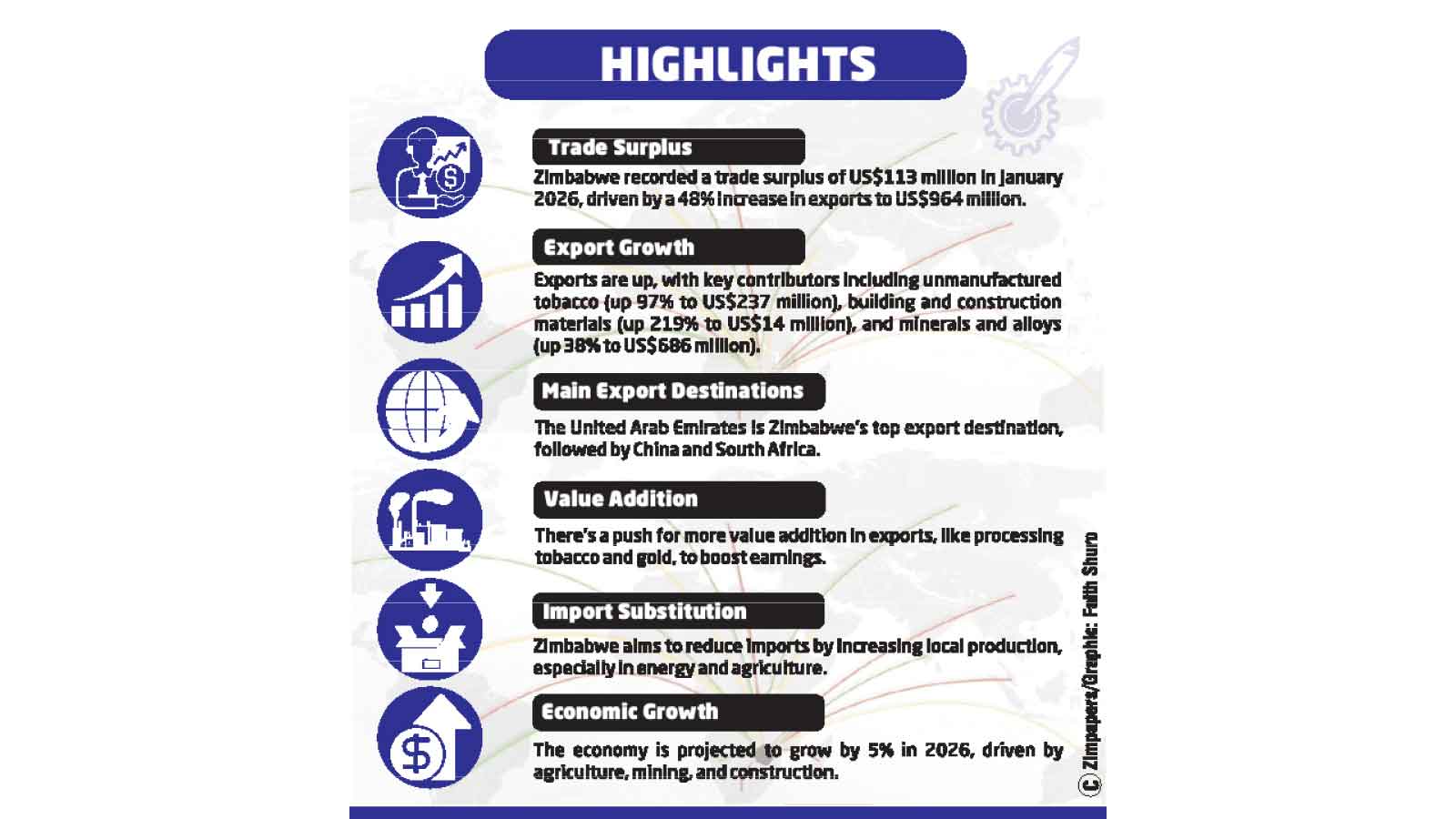
Trade Focus-Allan Majuru
ZIMBABWE’S export drive has started the year on a firm footing, with the country recording a trade surplus in January as exports outpaced imports, highlighting the impact of ongoing economic reforms and deliberate efforts to position the country at the centre of global supply chains.
Latest trade statistics show that in January 2026, Zimbabwe’s exports stood at US$964 million, representing a 48 percent increase from the US$652 million recorded in the same period in 2025.
Imports grew at a slower pace of 17 percent to US$855 million, up from US$729 million last year.
As a result, the trade deficit narrowed by 249 percent, effectively reversing the deficit to post a trade surplus of US$113 million, compared to a deficit of US$76 million recorded during the same period a year ago.
This positive shift reflects sustained reforms, improved production efficiencies and a coordinated Government approach that is steadily reducing impediments to trade while strengthening the ease of doing business environment.
The Government’s thrust has been deliberate and consistent — to anchor economic growth in trade, industrialisation and value addition, while ensuring that Zimbabwe takes its place within regional and global value chains.
President Mnangagwa reaffirmed this commitment during his interface with exporters at the ZimTrade Annual Exporters Conference held in Bulawayo recently.
“On its part, Government continues to simplify trade processes, reduce the cost of doing business and to modernise border management systems,” he said.
“Export competitiveness is not only being enabled by trade policy but through a whole-of-Government approach. This has seen the prevailing macro-economic stability, investment facilitation, streamlined incentives, improved access to finance, as well as predictable and investor-friendly environment for exporters.”
The President added: “It is commendable that the ongoing reforms have also improved policy coherence, especially in the export drive that is anchored on efficient production systems.”
In recent months, the Government has implemented a series of measures aimed at reducing the cost of doing business.
Levies and fees across various sectors have been reviewed, with some significantly reduced and others removed altogether.
Border management systems are undergoing modernisation to shorten clearance times and enhance transparency.
Regulatory processes have been streamlined to eliminate duplication, while digital platforms are increasingly being adopted to simplify compliance and licensing procedures.
The ease of doing business agenda is being pursued as a direct enabler of trade.
Exporters require a stable macro-economic environment, predictable policies and efficient institutions to compete effectively in international markets.
Progress in these areas is strengthening production systems and restoring business confidence. The improved trade balance in January 2026 demonstrates the cumulative impact of these policy adjustments.
As macro-economic stability takes hold and investment facilitation improves, exporters are scaling up production, consolidating traditional markets and entering new ones.
These reforms are reflected in the country’s trade performance.
Exports of value-added products increased by 31 percent, rising to US$40,6 million in January 2026 from US$31,1 million recorded in the same period in 2025.
This growth signals ongoing efforts to promote beneficiation and industrialisation, consistent with the national export strategy.
Movers
Unmanufactured tobacco exports increased by 97 percent to US$237 million in January 2026, up from US$120 million in 2025.
The sector contributed 25 percent to total exports, up from 18 percent in January 2025.
Increased output and firm international demand underpinned this performance.
Building and construction materials registered a notable surge, with exports rising by 219 percent to US$14 million, from US$4,4 million in the comparable period last year.
Major exported products included semi-finished products of iron or non-alloy steel amounting to US$6 million, iron and steel bars and rods (forged, including twisted and uncoiled) at US$6,2 million, and unglazed ceramic flags at US$700 000.
Growing infrastructure development across the region continues to create demand for these products.
Horticulture exports increased by 3 percent to US$2,3 million from US$2,2 million recorded during the same period in 2025. Tea exports rose to US$1,3 million from US$890 000, while fresh flowers amounted to US$380 000 in 2026, up from US$314 000 in 2025.
Although modest, this growth reflects sustained efforts to meet quality standards and maintain market access.
Packaging and stationery exports went up from US$500 000 to US$1,1 million, translating to over 120 percent growth.
Cartons and boxes were the major exported products in this category, contributing US$913 000.
Expansion in this segment indicates strengthening industrial linkages within the domestic economy and the region.
Minerals and alloys exports rose by 38 percent from US$496 million to US$686 million.
Gold remained the major contributor, increasing from US$291 million to US$499 million, a 71 percent rise supported by favourable prices and improved deliveries.
Lithium concentrates exports amounted to US$27 million, up from US$13 million, translating to over 100 percent growth as Zimbabwe consolidates its position in the battery minerals value chain.
Shakers
Despite the overall positive performance, some sectors recorded declines.
Clothing, textile and footwear exports went down by 11 percent from US$1,5 million in January 2026. Major exported products in the sector included men’s or boys’ suits, ensembles, jackets, blazers and trousers amounting to US$440 000, down from US$630 000 in the previous year.
Competitive pressures and production constraints remain areas requiring attention.
Hides and skins exports amounted to US$435 000 in January 2026, down from US$1,5 million during the same period in 2025, translating to a 72 percent decrease.
Major exported products included raw hides and skins, fresh or preserved, not tanned.
The sector will require targeted interventions to restore volumes and value.
Arts and crafts exports decreased from US$900 000 in January 2025 to US$600 000 in January 2026, representing a 33 percent decline.
Enhanced market promotion and branding initiatives could help unlock the sector’s potential.
Insights on export destinations
Market diversification continues to gather momentum, with both traditional and non-traditional markets registering growth.
Exports to the United Arab Emirates amounted to US$500 million, contributing 51,6 percent to Zimbabwe’s total exports, up from 45 percent in 2025.
Trade with this market is largely anchored by gold, which recorded significant value growth.
China emerged as the second-largest market, with exports increasing by 121 percent to US$214 million. This performance displaced South Africa as the second-largest destination market, whose imports from Zimbabwe stood at US$129 million in January 2026.
Although South Africa remains a key trading partner, faster growth in Asian markets reflects shifting demand patterns and strengthened economic cooperation.
Non-traditional markets are increasingly contributing to export growth.
Exports to Indonesia grew by 345 percent to around US$12 million, from US$2,7 million recorded the previous year.
Exports to Russia amounted to US$15,8 million in January 2026, compared to no recorded exports during the same period in January 2025. Algeria recorded US$5,3 million in January 2026, further broadening Zimbabwe’s export footprint.
Allan Majuru is the chief executive officer of ZimTrade.



