


 Online Reporter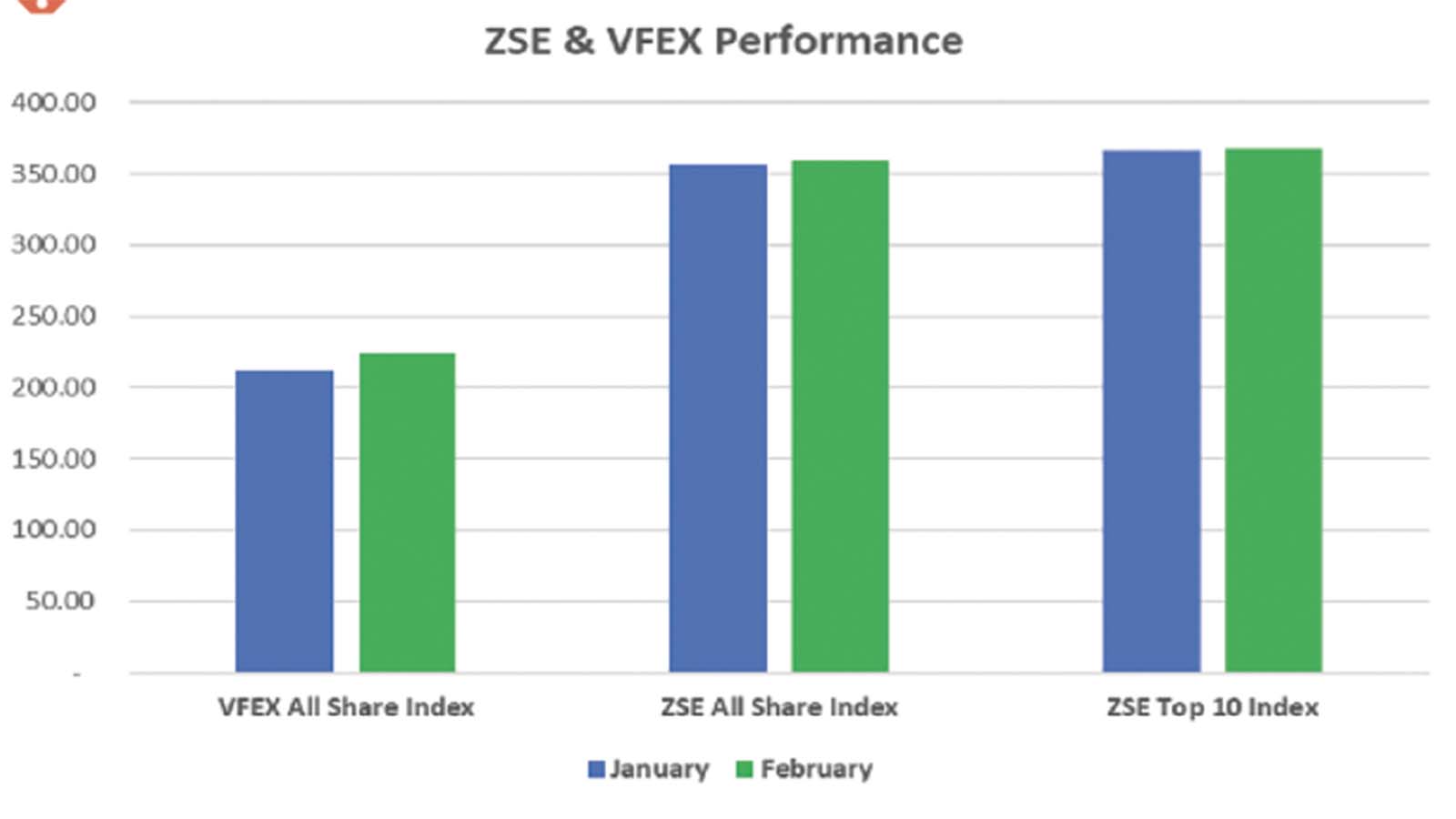
Nelson Gahadza
BOTH the Zimbabwe Stock Exchange (ZSE) and the Victoria Falls Stock Exchange (VFEX) extended gains recorded in January, reflecting improving investor sentiment and rising trading activity.
According to latest market data, trading on the ZSE maintained its upward trajectory in February, with market turnover rising more than 111 percent month-on-month.
This was largely underpinned by a sharp increase in foreign participation and improved trading activity.
Turnover rose to ZiG1,93 billion in February, up from the ZiG914,5 million recorded in January, reflecting renewed investor appetite. The strong growth in turnover occurred despite a decline in the volume of shares traded, suggesting that higher-value transactions and increased participation by institutional investors were key drivers of the February performance.
Foreign investor activity played a significant role in this growth, as foreign purchases climbed sharply to ZiG866,6 million in February, compared to just ZiG11,2 million in January, indicating a robust return of offshore investors to the market.
At the same time, foreign sales increased to ZiG233,6 million, up from ZiG149,9 million in the previous month, but remained well below purchases.
This resulted in a sizeable net inflow during the period.
Trading activity also improved during the month under review, with the number of trades increasing to 2 859 in February from 2 347 in January, pointing to broader market participation and increased liquidity across several counters.
Market analysts suggest the rebound in foreign participation reflects growing investor interest in select counters, as well as improved confidence in a market environment that has remained stable for a sustained period.
Based on market data from late 2025 into early 2026, the most actively traded counters by turnover on the ZSE continue to be dominated by heavyweights in the telecoms, consumer goods and financial sectors.
Delta Corporation, the country’s largest beverages manufacturer, has been among the most-traded counters on the ZSE.
Over the past three months (December 3, 2025 to March 5, 2026), the counter traded a total volume of 46,5 million shares valued at ZiG1,26 billion, averaging a daily volume of 737 839 shares.
The current share price of Delta stands at ZiG28,76, representing a gain of 38,9 percent since the start of the year when it opened at ZiG20,70.
The counter has traditionally been viewed as a defensive stock, benefitting from steady revenue generation and consistent demand for its products.
Trigrams Investments analyst Mr Wafa Kuchera said ZSE trading was driven primarily by activity in Econet Wireless ahead of a crucial meeting regarding its delisting plans.
“This activity was mostly from institutional investors adjusting their positions in the counter based on their assessment of the detailed circular to delist. This shifting generated a lot of liquidity, which was beneficial for the overall market,” he said.
Econet Wireless has also featured among the top-traded companies.
The company began the year with a share price of ZiG6,1 and has since gained 65,7 percent to reach the current price of ZiG10,1. The telecommunications giant has benefitted from expectations of improved earnings, driven by growing demand for mobile data and the continued expansion of its digital platforms.
However, the company is in the process of delisting from the ZSE to an over-the-counter trading platform.
As part of a long-term strategy to unlock value from its extensive network and real estate assets, the group will also list its newly carved-out infrastructure business, Econet InfraCo, on the VFEX.
Performance across major indices further reflected the steady improvement in sentiment.
The All-Share Index rose to 359.11 points in February, up from 356.04 points in January, while the Top 10 Index edged up to 367.23 points from 366.68 points.
Meanwhile, the mining index remained largely unchanged at approximately 122.5 points.
Market capitalisation registered a modest increase, rising to ZiG111,89 billion in February from ZiG110,65 billion in January.
The VFEX also sustained its positive momentum into February 2026, with the All-Share Index posting solid gains, while market activity strengthened on the back of improved trading volumes.
Statistics show that the VFEX All-Share Index rose by 6 percent to 224.06 points in February, up from 211.36 points in January, reflecting firm appetite for the United States dollar-denominated bourse.
Market turnover on the VFEX grew by 4,3 percent to US$10,74 million, up from US$10,30 million in January.
Trading volumes followed a similar trajectory, rising by 6,2 percent to 32,8 million shares. The increase in activity was further reflected in the number of trades executed, which jumped by 26,5 percent to 1 875 in February from 1 482 in January.
Market capitalisation on the dollar-denominated exchange edged higher during the period, climbing to approximately US$2,54 billion from US$2,49 billion.
Investment analyst Mr Enock Rukarwa noted that a key fundamental driving growth, especially for the VFEX, has been the increasing dollarisation within the economy.
The exchange, established to attract foreign capital and provide a hedge against local currency volatility, continues to draw interest from regional and international investors seeking exposure to Zimbabwe’s resource-based companies.
Analysts conclude that maintaining this positive trajectory will depend on continued currency stability, policy consistency and improved liquidity within the financial system.



