admin
admin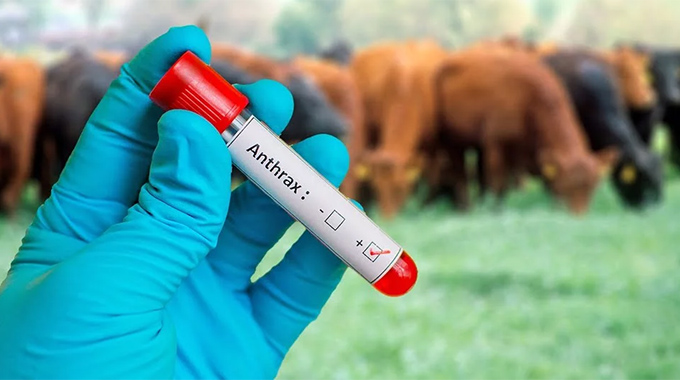
Samuel Kadungure Farming Matters
ANTHRAX outbreak has been reported in Buhera and farmers are being warned to vaccinate their animals against the hemorrhagic infection that now poses serious threat to efforts being made to improve the quality of livestock in the district.
Anthrax – a highly infectious and fatal disease to mammals and humans remains a far greater threat to livestock, as infected animals left untreated, die within a few days.
Anthrax is caused by a relatively large spore-forming rectangular shaped bacterium called Bacillus anthracis and it is most common in wild and domestic herbivores such as cattle, sheep and goats, but can also be seen in humans exposed to tissue from infected animals, contaminated animal products or directly to spores under certain conditions.
In herbivores, anthrax commonly presents as an acute septicemia with a high fatality rate, often accompanied by hemorrhagic lymphadenitis.
Following the outbreak, movement of cattle from Buhera has been suspended with immediate effect, and those caught moving animals from these affected areas will be penalised because the spread of the disease is partially blamed on illegal animal movements.
Natural anthrax is endemic in Zimbabwe where its bacillus spores can live for decades in dry soil and are ingested by animals ruminating for remnants of vegetation in the driest months of September and October. Anthrax outbreaks happen occasionally in livestock herds and wild animals in Zimbabwe, usually in the Gonarezhou area.
Animals typically contract the disease by ingesting or inhaling spores that can survive in soil for decades. Once infected, livestock can die within hours.
Anthrax bacteria react to drought and other harsh conditions by producing more spores, and fear abounds that the current conditions might be ripe for disease. The bacteria’s spores seem to survive better in alkaline soil with high levels of calcium, a type abundant in the province.
In general, however, the spores are extremely durable and can lie dormant for years. Once ingested, they reconstitute and spread rapidly through the body of warm-blooded animals.
Grazing animals may become infected when they ingest sufficient quantities of these spores from the soil.
In addition to direct transmission, biting flies may mechanically transmit spores from one animal to another.
Raw or poorly cooked contaminated meat is a source of infection for carnivores and omnivores; anthrax resulting from contaminated meat consumption has been reported in humans, dogs, cats and wild carnivores.
Humans usually get anthrax through direct contact with infected livestock, often when spores get into a cut on the skin or eating infected carcasses.
Without treatment, anthrax can be fatal, but early treatment with antibiotics is very effective.
Though there were no immediate reports of human deaths in the outbreak, veterinary authorities in the district have recorded several of infected cattle, hence the ban on animal movements.
Anthrax has killed hundreds of animals and several people mostly in the communal parts of Manicaland in the past years.
The assistant District Administrator for Buhera, Mr Elisha Mushayavanhu, last week warned that the risk of hemorrhagic infection may be greater with the dry conditions in the district.
“While we celebrate efforts being made by our partners to improve the quality of our breeds, we would like to warn you of the outbreak of anthrax in the district. Anthrax has been detected in Ward 16, and we have notified the veterinary department about the developments.
“We are appealing to farmers in Buhera to mobilise resources and vaccinate their cattle against this disease other than wait for the Government intervention, as it may take long. We should not sit on our laurels while our cattle die. We must take a leading role to prevent our animals against the disease,” said Mr Mushayavanhu.
Anthrax is a notifiable disease and the division of veterinary services must be notified of suspected cases.
Mr Tinashe Tsepete, the Goal Zimbabwe project manager, said they were assisting the affected farmers with anthrax and black leg vaccine.
“We received a request and we have assisted them with a two-in-one vaccine for anthrax and blackleg, targeting the three wards to which we have donated bulls. We have advised the farmers to pay a nominal fee of 50 cents per animal so that the veterinary department generates funds to buy more vaccines and roll out the programme to other areas,” said Mr Tsepete.
Though efforts to get a comment from the Provincial Veterinary Officer, Dr Charles Guri, were fruitless, a source from the department’s Buhera offices confirmed the outbreak.
“The carcasses bloat and decompose very rapidly. The carcasses of suspected anthrax cases should never be opened and the meat should never be consumed. Should a case of anthrax occur on your farm, you may help to stop the spread of infection by burning or burying dead animals, and disinfecting the place using the most effective disinfectants like quicklime, formalin or caustic soda,” said the source.
Symptoms
Very occasionally some animals may show trembling, a high temperature, difficulty breathing, collapse and convulsions before death. This usually occurs over a period of 24 hours.
After death, blood may not clot, resulting in a small amount of bloody discharge from the nose, mouth and other openings.
Prevention, treatment and control
Infection is usually acquired through the ingestion of contaminated soil, fodder or compound feed. Anthrax spores in the soil are very resistant and can cause disease when ingested even years after an outbreak. The spores are brought to the surface by wet weather, or by deep tilling, and when ingested or inhaled by ruminants the disease reappears.
Where an outbreak has occurred, carcasses must be disposed of properly. The carcass should not be open as exposure to oxygen will allow the bacteria to form spores and premises should be quarantined until all susceptible animals are vaccinated.
Vaccination in endemic areas is very important. Although vaccination will prevent outbreaks veterinary services sometimes fail to vaccinate when the disease has not appeared for several years. But because the spores survive for such lengthy periods, the risk is always present.
Anthrax is controlled through vaccination programs, rapid detection and reporting, quarantine, treatment of asymptomatic animals and burning or burial of suspect and confirmed cases.
In livestock, anthrax can be controlled largely by annual vaccination of all grazing animals in the endemic area and by implementation of control measures during epizootics.
The none-capsulated Sterne-strain vaccine is used almost universally for livestock immunization. Vaccination should be done 2–4 weeks before the season when outbreaks may be expected. Because this is a live vaccine, antibiotics should not be administered within a week of vaccination. Early treatment and vigorous implementation of a preventive program are essential to reducing losses among livestock. Livestock at risk should be immediately treated with a long-acting antibiotic to stop all potential incubating infections.
This is followed by vaccination 7–10 days after antibiotic treatment.
Any animals becoming sick after initial treatment and/or vaccination should be retreated immediately and revaccinated a month later.
In addition to therapy and immunisation, specific control procedures are necessary to contain the disease and prevent its spread. These include the following:
1. Notification of the appropriate regulatory officials;
2. Rigid enforcement of quarantine (after vaccination, 2 weeks before movement off the farm, 6 weeks if going to slaughter);
3. Prompt disposal of dead animals, manure, bedding, or other contaminated material by cremation (preferable) or deep burial;
4. Isolation of sick animals and removal of well animals from the contaminated areas;
5. Cleaning and disinfection of stables, pens, milking barns, and equipment used on livestock;
6. use of insect repellents;
7. control of scavengers that feed on animals dead from the disease; and
8. observation of general sanitary procedures by people who handle diseased animals, both for their own safety and to prevent spread of the disease. Contaminated soils are very difficult to completely decontaminate, but formaldehyde will be successful if the level is not excessive. The process generally requires removal of soil.



 Online Reporter