Theseus Mauruki Shambare in Binga
PROJECTS valued at over US$3 million implemented through partnerships in Binga District are driving development and strengthening community resilience, helping the district climb to position 24 out of 92 local authorities in Zimbabwe’s performance rankings.
Under the Second Republic’s governance reforms, local authorities are now bound by performance-based contracts designed to enhance accountability and ensure measurable commitment to improved service delivery.
Binga District Development Coordinator Mr Land Siansole Kabome said the progress reflects strengthened collaboration between Government, development agencies and humanitarian organisations in delivering programmes aimed at improving service delivery and climate resilience.
He said the district was now working towards achieving a single-digit ranking as it aligns local development programmes with Government’s Vision 2030 agenda.
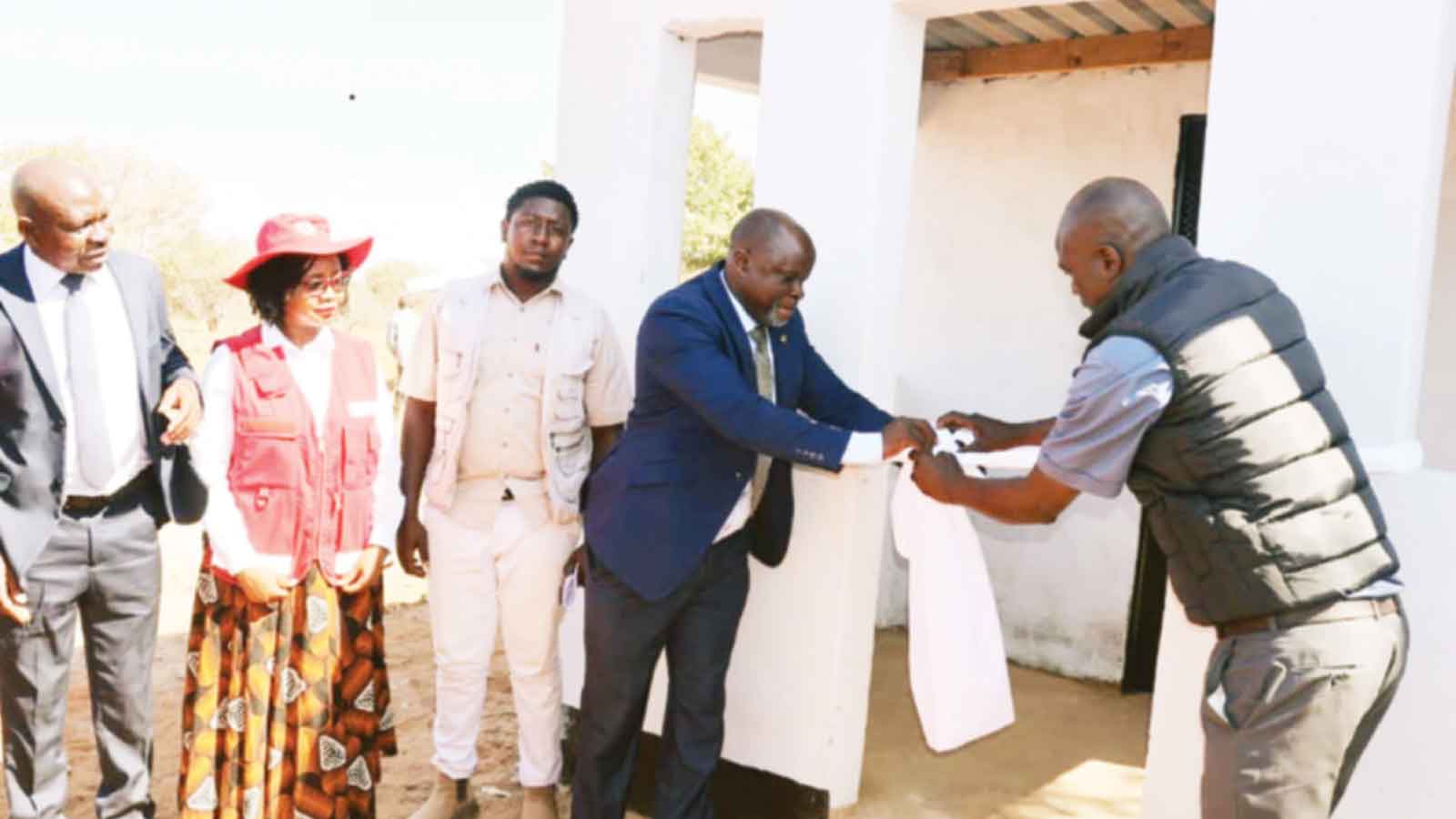
He made the remarks during the handover of the Mupambe Water Supply Scheme and Mankobole Dip Tank by the Zimbabwe Red Cross Society (ZRCS) on Thursday, projects aimed at improving access to safe water and protecting livestock-based livelihoods.
Kabome said coordinated partnerships had allowed Binga to attract and implement projects that address climate-related challenges affecting communities.
He cited the Climate Adaptation, Water and Energy Programme (CAWEP), supported through the United Nations Development Programme (UNDP), as one of the major interventions complementing district development efforts.
“The pipeline is 62 kilometres and is being implemented to the tune of US$3 million,” Kabome said.
The CAWEP project is supporting communities in Ward 9, Ward 10 and Ward 13, including the development of the 20-hectare Saba Green Valley Irrigation Scheme and four one-hectare irrigation schemes in Ward 9.
Kabome said collaboration among partners was critical in avoiding duplication of efforts and ensuring communities receive complementary support.
“We are saying we brought clean water, potable water. We also brought raw water. So Red Cross took some water from the UNDP project and supported the dip tank,” he said.
The handover ceremony saw ZRCS officially transfer the Mupambe Water Supply Scheme and Mankobole Dip Tank to community structures for management and sustainability.
ZRCS President Mr David Chaliyanika said the projects were identified through community planning processes, ensuring they responded to the actual needs of beneficiaries.
“These projects were not imposed from outside; they were actually identified and prioritised by the communities themselves, who worked tirelessly to develop sustainable solutions,” he said.
The Mupambe Water Supply Scheme addresses growing water challenges worsened by prolonged drought seasons linked to climate change.
Chaliyanika said traditional water sources had become increasingly unreliable, affecting access to drinking water and household activities.
“The Mupambe Water Supply Scheme came at the right time as the community is facing serious water shortages which are made worse by increased drought seasons due to climate change,” he said.
The solarised and mechanised borehole is now supplying water to Mupambe Primary School, Mupambe Secondary School and surrounding villages, including Kakonde 1, Kakonde 2, Kakonde 4, Kakonde 5, Kakonde 8, Kakonde 9, Mupute 6, Nkombo 5 and Nkombo 6.
Mupambe Primary School has an enrolment of 574 learners, while Mupambe Secondary School has 193 learners.
Meanwhile, the Mankobole Dip Tank is expected to strengthen livestock disease control and protect a key source of wealth for rural households.
Reading remarks on behalf of ZRCS Secretary-General Mr Elias Hwenga, Human Resources and Administration Director Mr Geshum Hombarume said the interventions represented more than infrastructure development.
“Access to safe water and improved livestock health are not isolated development interventions — they are foundations for dignity, resilience and sustainable livelihoods,” Hwenga said.
He said the dip tank would help address livestock challenges in Mankobole, where tick-borne diseases have threatened cattle, household incomes and food security.
“The facility will now bring essential animal health services closer to the community, helping to reduce livestock losses, improve productivity, strengthen food security and protect a key livelihood asset for households,” he said.
Hwenga said the Mupambe Water Supply Scheme was responding to pressure caused by recurring droughts and drying traditional water sources.
“Through the solarisation and mechanisation of the borehole and construction of the pipeline system, learners at Mupambe Primary and Secondary Schools, together with surrounding villages, will now have improved access to water,” he said.
Finnish Red Cross Programme and Finance Officer Ms Loice Munhenga said the Mankobole Dip Tank was prioritised by the community through its local action planning process.
She said livestock remained central to rural livelihoods and needed protection from diseases.
“Livestock is the community’s cornerstone of wealth and livelihoods and therefore needs to be protected from diseases,” Munhenga said.
The projects are part of the Climate-Smart Resilience Project implemented by ZRCS, with support from the Finnish Red Cross and Danish Red Cross, aimed at helping drought-prone communities move from responding to climate shocks towards long-term adaptation.