

 Online Reporter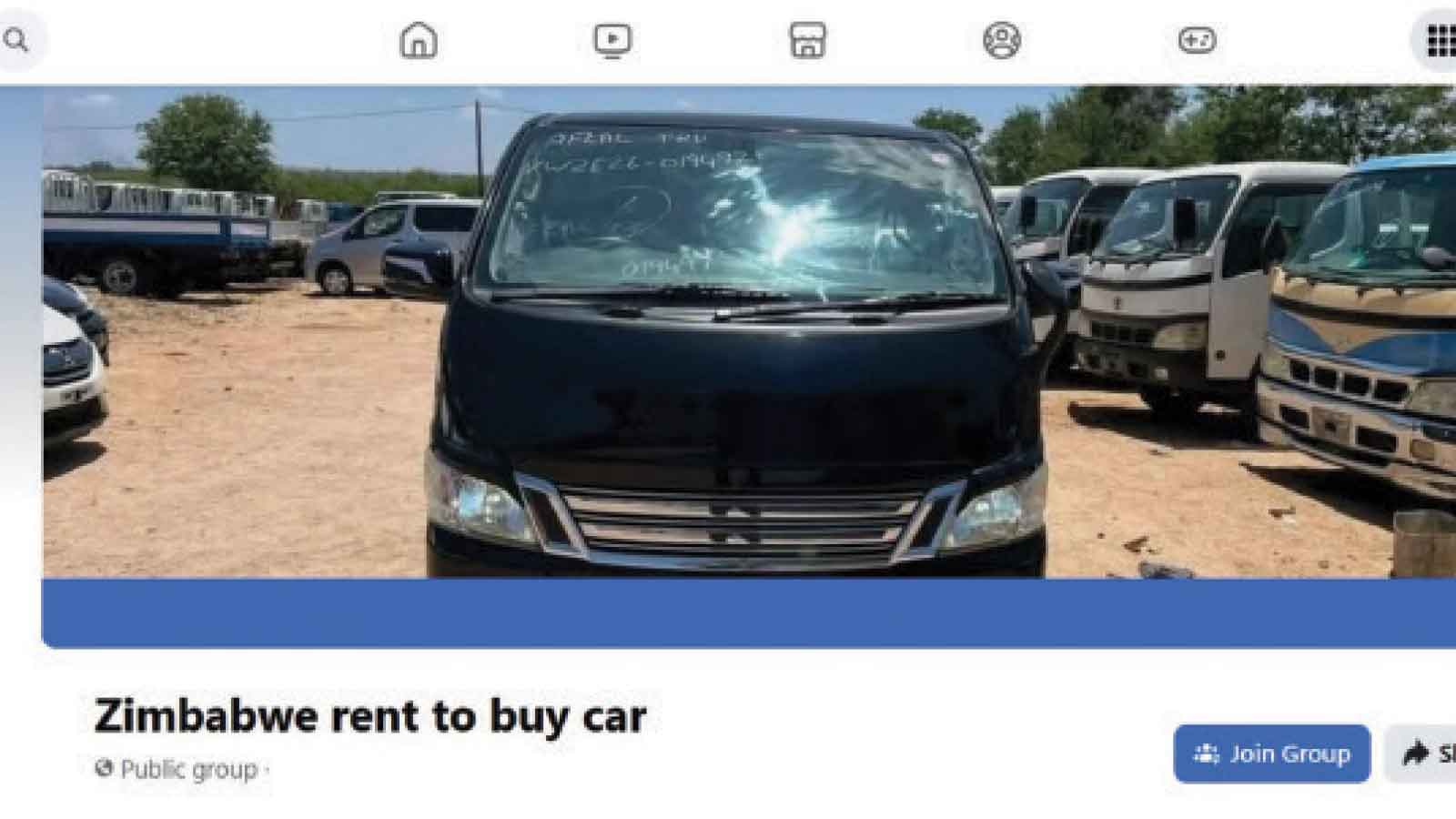
Emmanuel Kafe-Check Point Desk
ON Facebook Marketplace, WhatsApp groups and Telegram channels, the adverts are relentless.
Glossy photos of Toyota Aqua, Honda Fit and Mazda Demio models sit beside seductive captions: “Rent-to-Buy –— No Credit Check. Drive Today. Own Tomorrow.”
For thousands of Zimbabweans locked out of formal vehicle finance, the promise feels like a lifeline.
But behind the images and emojis lies a fast-mutating scam ecosystem that has swallowed millions of dollars, shattered livelihoods and exposed deep regulatory blind spots.
Over several months, Check Point Desk examined how rent-to-buy car schemes operate from recruitment to collapse, who is behind them, and why despite repeated complaints they continue to resurface under new names.
Selling hope on social media
The schemes thrive in plain sight.
Operators saturate Facebook Marketplace, buy-and-sell groups, WhatsApp community forums and Telegram channels with professionally worded advertisements crafted to mimic legitimate car dealerships.
The offers are deliberately pitched to those excluded from bank loans, promising low deposits ranging from a few hundred dollars, no credit checks, instant delivery and flexible monthly instalments.
Many of these pages are carefully dressed to look authentic. They carry logos, claim physical office addresses often lifted from unrelated businesses and display vehicle images scraped from Japanese auction websites or genuine local car yards.
To reinforce credibility, operators deploy agents who pose as satisfied customers, flood comment sections with testimonials and privately message interested buyers.
In several cases documented by Check Point Desk, these agents were former victims themselves, pressured into recruiting others in the hope of recovering lost money.
Contracts that look legitimate
Once initial contact is made, prospective buyers are quickly shifted to WhatsApp under the pretext of faster service.
There, victims are presented with rent-to-buy contracts printed on letterheads, copies of purported company registration documents and images of vehicles said to be “in stock.”
But there is a troubling pattern.
Company ownership details are vague or inconsistent, delivery timelines are left entirely at the discretion of the company, and deposits are explicitly stated as non-refundable.
Interestingly, there is no provision allowing buyers to physically inspect the vehicle before payment.
In several instances, the company name appearing on the contract differs from the one used in the original advertisement.
Following the money
Payment instructions direct victims to mobile money platforms or cash payments made through agents. Funds are rarely paid into corporate accounts.
Instead, deposits are routed through individual accounts and withdrawn or transferred onward within days, leaving little trace.
Receipts, when issued, are generic and lack basic accounting details such as serial numbers or tax information.
Once the money is paid, the balance of power shifts decisively away from the buyer.
After payment, delivery dates begin to slide.
Victims are told the vehicle is stuck at Beitbridge, delayed at customs or held up by a broken-down transporter.
Communication remains just frequent enough to maintain hope. Some buyers are even asked to pay additional fees for insurance, registration or expedited clearance, deepening their financial exposure.
Eventually, communication slows, then stops altogether. Phones go unanswered.
WhatsApp messages are left unread.
Facebook pages disappear without warning.
Within weeks, a new page surfaces — using the same vehicle images, the same language and the same tactics, but operating under a different name.
Recurring names, shifting identities
In tracing payment trails and digital footprints, Check Point Desk identified a cluster of recurring names, phone numbers and aliases linked to multiple rent-to-buy schemes operating under different banners.
Among those flagged by victims is Ian Nyathi, who uses the mobile number 0778 303 055 and operates on Facebook under the name Baba Matanho.
Another is Admire Nzou (0786 835 844), who trades online as Madzibaba Joshua.
A third, Munyaradzi Chikweshe (0784 251 067), uses the Facebook name Mambo Eriya.
The three are associated by victims with a purported company calling itself SBT Rent-to-Buy Cars, a name that appears on advertisements and WhatsApp correspondence.
Another alleged operator frequently cited is Langton Zvarimwa (0772 979 858), who runs a WhatsApp group named Modern Car Sales.
Victims say Zvarimwa typically requests initial payments described as fuel or tollgate fees, after which communication abruptly ceases.
Check Point Desk also reviewed a WhatsApp group operating under the name Mupostori Rent-to-Buy, administered by multiple accounts linked to the cellphone numbers 0776 244 952, 0789 409 267, 0789 409 858, among others.
Victims allege that once payments are made, administrators block complainants’ numbers and remove them from the group.
In an effort to obtain comment, this reporter attempted to contact all the listed numbers.
None of the calls went through.
WhatsApp messages were delivered, indicated by double ticks, but no responses were received by the time of publication.
The human cost
For victims, the consequences are immediate and personal. Tariro (surname withheld), a 34-year-old nurse from Harare West, paid US$800 after being told the car would help her commute safely to night shifts.
She signed contracts and kept receipts.
Three months later, there was still no vehicle. When she visited the listed office address, the building manager told her the company had never operated from there.
Today, she relies on overcrowded kombis and is repaying a loan she took to raise the deposit.
Joseph (surname withheld), a 42-year-old cross-border trader, sharing his story on social media said he was shown images and a video of a silver Honda Fit.
After paying US$1 200, he was asked for an additional US$300 for clearance.
That was when he realised something was wrong. He filed a police report, but no arrests have followed.
Across cases reviewed by Check Point Desk, the same timeline emerges.
A new Facebook page launches and advertises aggressively, responding quickly to enquiries.
Deposits are collected within the first few months, followed by a period of delays explained away as logistical challenges.
Complaints then intensify, administrators become evasive or hostile, and finally the digital trail vanishes.
Within months, the operators re-emerge under a new name and restart the cycle.
This pattern has repeated itself across at least a dozen schemes identified in Harare alone.
Who is behind the schemes?
While many victims believe there is a single mastermind, evidence points instead to loosely connected networks rather than one central syndicate.
Typically, a small core group controls the money and digital accounts, supported by temporary agents paid commissions per recruit.
Front companies are cheaply registered or not registered at all. Certain names recur across contracts and payment instructions, yet prosecutions remain rare.
Several victims told Check Point Desk that attempts to confront operators in person were met with threats or claims that the business had “changed management.”
Advocate Misheck Mandaira, who specialises in commercial law said Zimbabwe has no clear regulatory framework governing rent-to-buy vehicle schemes.
“This legal grey area allows operators to argue that they are not selling cars, but merely offering rental services with an option to buy.
“Law enforcement faces additional hurdles, including cross-jurisdictional money flows, victims reluctant to report cases due to shame, and disputes over whether the matter is civil or criminal in nature,” he said.
National police spokesperson Commissioner Paul Nyathi said that although the police are aware of cases of this nature, many victims do not report them, making it difficult for authorities to take timely action.
“We urge members of the public to use proper and recognised channels when purchasing vehicles to avoid being duped. In the event that one is defrauded, the matter should be reported to the police promptly so that appropriate action can be taken,” he said.
Comm Nyathi urged the public to exercise vigilance when using social media marketplaces, noting that many scams were perpetrated through such platforms.




 Bongani Ndlovu