Online Reporter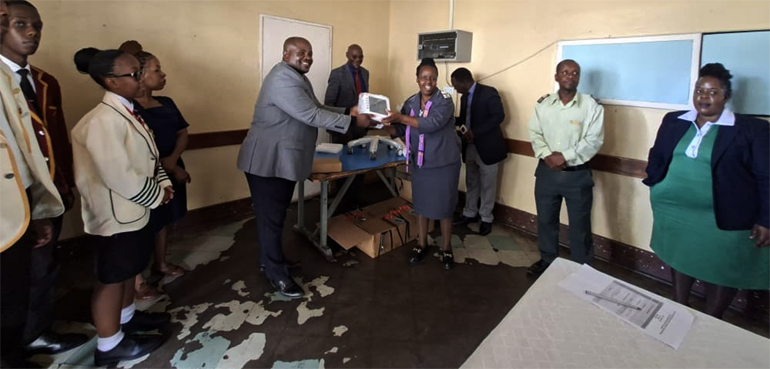
Tendai Gukutikwa
Health Reporter
IN a move aimed at strengthening healthcare service delivery at Victoria Chitepo Provincial Hospital, First Class Group of Schools donated a patient monitoring machine valued at US$1 500 to the male medical ward on Tuesday.
The donation is expected to improve patient care by enabling medical staff to closely monitor vital signs such as heart rate, blood pressure and oxygen levels in real-time.
First Class Group of Schools Director General, Mr Stephen Mutsongodza said the institution decided to support the hospital because of the critical role it plays in providing affordable healthcare services to the community.
“We chose the hospital because it provides services to the generality of Zimbabweans at affordable prices as a public hospital. We felt that in that regard we can contribute in a small way to support the work that is being done here,” he said, adding that improving access to quality healthcare is essential for the country’s development aspirations, noting that a healthy population is fundamental to national progress.
“As a country, we are working towards achieving Vision 2030 of becoming an upper-middle-income economy, something that President Emmerson Mnangagwa is always talking about. One of the key requirements for that vision is having a healthy nation. Institutions such as schools, businesses and community organisations must therefore play their part in supporting health services,” he said.
The patient monitoring machine has been specifically designated for use in Male Ward B, where it will assist nurses and doctors in continuously tracking the condition of admitted patients.
Mr Mutsongodza said the contribution is part of the school group’s commitment to corporate social responsibility and community development.
“As an institution deeply rooted in Mutare, we recognise the vital healthcare services your facility provides. This contribution represents our commitment to corporate social responsibility and our desire to support frontline staff in providing high-quality care to patients,” he said, adding that the equipment will help medical staff detect changes in a patient’s condition quickly, thereby improving the chances of timely medical intervention.
“We believe this equipment will assist your medical team in the effective, real-time tracking of vital signs, ultimately improving patient outcomes within the ward,” he said.
Mr Mutsongodza also said the gesture is inspired by his personal connection to the community, having grown up in Sakubva.
“I have a background in Sakubva, and I know how important this hospital is to the people in the surrounding communities. Many families rely on this facility for treatment because it offers services at affordable prices. That is why we felt it was important to come in and support the hospital so that it continues to provide quality healthcare to the people,” he said.
Nurse-in-charge for the male medical ward, Mr Godfrey Shumba expressed gratitude to the school group for the donation, describing it as a timely intervention that would enhance patient care.
“I would like to thank the First Class Group of Schools for this important donation. The vital patient monitoring machine will go a long way in assisting us in the provision of quality nursing care to our patients,” he said, adding that patient monitoring machines are essential in modern healthcare because they allow medical personnel to continuously observe patients’ vital signs and respond quickly when complications arise.
“With this equipment, we are able to monitor our patients more effectively and respond promptly if there are changes in their condition. This helps improve the quality of care that we provide,” he said.
He also commended the school’s leadership, staff and learners for taking the initiative to support the health sector.
Mr Shumba expressed hope that the gesture will inspire other organisations and private players to assist public health institutions facing resource constraints.
He said modern equipment such as the patient monitoring machine plays a critical role in improving treatment outcomes, particularly for patients who require close observation due to serious or unstable medical conditions.