Sundaymail Editor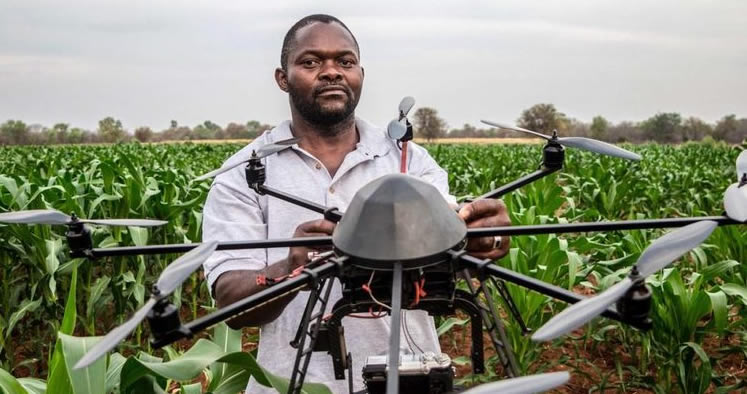
Oga Chapwanya
Introduction
Political fallouts with America have in most cases attracted aerial raids from the United States. Amidst great controversy, the US has never been hesitant to deploy drones in its military exploits. Today, the whole of SADC is under serious threat of drone attack! This is a unique form of attack that SADC needs to get prepared to with or without any political fallout with world super powers!
Historical background of drones
Drone technology became increasingly visible in the 1930s as miniature airplanes were remotely flown and controlled using radio frequencies. In the early 1960s, America seriously considered using unmanned aircraft after one of their pilots was captured by Soviet Union forces during a reconnaissance mission in which his plane was brought down.
The Gulf War of the 1990s saw tremendous advances in drone systems. Drones immediately became one of the most preferred defence equipment. This compelled the US to commit huge amounts of financial investment in the technology. Like other military breakthroughs of the past, drone technology was gradually transmitted into civilian use. Unmanned aerial vehicles are rapidly finding space in commercial applications!
What drones are
A drone is a tiny, independent or remote controlled aircraft. Several categories of these unmanned aerial vehicles exist between micro-drones and high altitude long endurance drones. Micro-drones weigh less than five kilograms with some of them being as tiny as an insect! They can be controlled within one kilometre range and can scale up an altitude of a quarter of a kilometre. On the contrary, huge drones are called high altitude long endurance crafts. These weigh above one and a half tonnes. “Macho-drones”, as they are sometimes called, are controllable over a distance of one thousand kilometres and can climb up to twenty kilometres above sea level.
Generally, drones can either have rotary wings like choppers or fixed wings. Those with rotary wings may have one, four, six, eight or more engines. Fixed wing drones also come in various shapes and sizes such as hang gliders and elliptical wings.
Drones are navigated by flight control software that is run on cellphones, tablets or microcomputers through Wi-Fi signal. With such technology, tasks that were traditionally done with manned aircraft are now being performed by drones.
Drones as an imminent disruption
In the past, drones have disrupted military plans of men of valour on the battlefield. The technology is set to perpetuate its disruptive nature but in this case transmitting such into non-military operations. Disruption from unmanned aerial vehicles is imminent on the SADC commercial front as it has been elsewhere in the world.
Drones are coming! Their transformational force is globally revolutionary. They are giving birth to new models of business, new markets, new breed of competitors, new careers, new training needs, new product categories and unique industries elsewhere in the developed world. Drones have rapidly assumed commercial operations.
Civilian applications of drones
Overwhelming evidence prevails on the efficacy of drones in various civilian applications around the world. Countries that are on the fore front in exploring this innovation include Britain, China, Canada, Singapore, Australia, Israel, US and South Africa, among others. In the United States, for instance, the commercial market for drones surpasses ten billion dollars with the cheapest unmanned aerial vehicle going for as little as two hundred United States dol-lars.
Applications that are presently being transformed by this technology are: filming, photography, wildlife management, surveys and anti-poaching, national border patrols, agricultural survey and planning, traffic observation on roads, disaster management and rescue missions, town planning and surveying, meteorology, and anti-smuggling among others.
Drones, thus, have proved viable in these applications in other parts of the world. It is the deployment of unmanned aerial vehicles in these non-military operations that SADC should be prepared to!
The key questions to SADC are: Is SADC prepared for the drone revolution? Will SADC choose to watch these developments from a distance and wake up one morning as a consuming market rather than a producer of drones?
In this coming wave of business disruption, SADC needs to search for “drone wisdom”.
Challenges of drone technology
The intrigue that engulfs drones is as enormous as the challenges that plague the technology.
In Great Britain, for example, Professor Sir David Omand GCB observed the absence of national policy to direct the drone revolution. Several countries are still grappling with the requisite regulatory framework that will ensure full integration of drones into their national airspace. Coming up with collision avoidance software for drones is still a mammoth task.
Massive improvements are needed in this area to promote safety in mid-air. There are numerous safety and security concerns on people and property on the ground. Drones can invade people’s privacy if they are fitted with high resolution cameras. They are also prone to hacking in which the control of a drone can be seized by employing Wi-Fi network commands to disconnect its original controller.
How SADC can avoid surprise attacks
The advent of drones, their eventual adoption and integration in economies follows the path of computer technology. It is a path that is sure to effect change. Such change is imminent, predictable, inevitable, and most interestingly, controllable if handled with foresight by all SADC institutions.
Colleges and universities need to generate great interest in their students, instructors, and researchers to undertake studies related to drones. To the best of the writer’s knowledge only Stellenbosch University, in South Africa has taken significant studies in keeping reasonable pace with the global drone debate.
They have issued several publications exploring the innovation. Drone related studies need not be limited to the technical “gobbledegook” of drones but can be extended to the managerial aspect as well given that this is where the market analytics and business models can be engineered. Law students can contribute significantly on the legal and regulatory aspects of the drone revolution within the African con-text.
The corporate world needs to sponsor the exploration of the technology by college students. Venture capitalists can help establish businesses that produce micro-drones. This is significant in supporting the notion that SADC needs to shift from being a consuming market to become a producer of emerging technologies. Micro-drones can be SADC’s entry point. No one is to be left out in preparations against the impending aerial raids! Policy makers in the region are expected to start gearing themselves up for what is coming.



 Online Reporter