admin
admin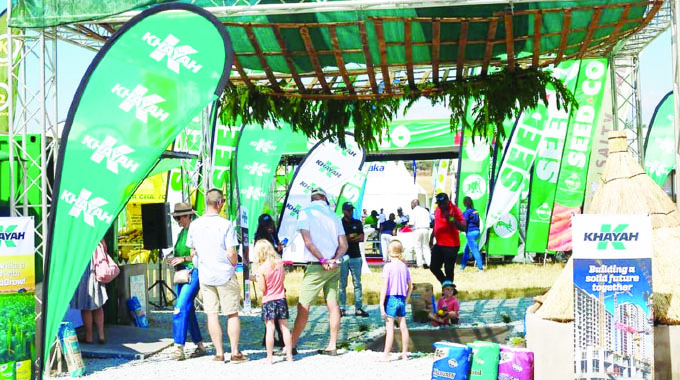
Zvamaida Murwira
Senior Reporter
Khaya Cement (formerly Lafarge Cement Zimbabwe) is set to commission its new vertical cement mill while it has earmarked US$11 million to revamp its plant as its production and sales level have doubled in recent months due to the Second Republic’s housing programme and the major infrastructural development.
At its inception, the Second Republic led by President Mnangagwa embarked on major infrastructural expansion that include road rehabilitation under the Emergency Road Rehabilitation Programme, dam construction, agriculture transformation schemes and a housing delivery programme consistent with its desire to attain an upper middle class economy by 2030 anchored by its economic blueprint, the National Development Strategy 1 (NDS1).
These programmes have boosted the cement industry and other downstream sectors that have benefited from the spin-offs of the massive projects, since the overwhelming bulk of construction materials are locally supplied. Khaya has also been pushing its productivity and efficiency, and is managing to reduce cement prices by close on 15 percent.
Building on the Government-driven growth in demand, Khaya Cement has also registered double-digit growth in dry mortar products driven by massive investment and industrial performance that has seen the firm projecting a 160 percent growth in the next three years.
In an interview at the weekend, chief executive officer Mr Innocent Chikwata said the Government’s expansion of infrastructural development had created a boon for their firm as it has created opportunity for them to move their products, something that has vindicated their decision to invest millions of US dollars in plant upgrade.
The resulting significant growth of production and sales levels have resulted in surge in employment creation and product price competitiveness.
In complementing the Government’s agriculture programme, Khaya Cement has provided lime to the Ministry of Lands, Agriculture, Water, Fisheries and Rural Development used to adjust soil pH, with Zimbabwean soils tending to be acidic.
“What we have done is to put our money where our mouth is. We have been delivering lime to the Ministry which helps regulate soil PH and in so doing we have contributed to food security as envisaged in Vision 2030,” said Mr Chikwata.
“On cement production and competitiveness, owing to the growth in industrial performance, cement used to cost US$10.35 when I joined the company in 2017, but it’s now US$9. We have bought bulk tankers and silos that will further give impetus on our performance and now we have set up a team of expertise who will explore ways to maintain the growth momentum. We are participating in the Government’s major infrastructure projects such as housing delivery, dam construction and road rehabilitation through provision of our products such as high quality cement.”
“We will be commissioning our vertical cement mill early next month which will be a huge event and great day for us. The plant has helped us double our capacity and it uses less energy and provides an improved quality.”
He said the vertical cement mill had created an opportunity for the development of high strength cement varieties and consistent product supply.A vertical cement mill is a type of a grinder used to grind material into extremely fine powder and is an energy efficient plant.
Outlining the journey his firm has gone through from the turbulence which temporarily halted operations, Mr Chikwata said the first stage was to stabilise the firm, engage creditors such as the National Railways of Zimbabwe who provide transport and Hwange Colliery who provide the raw material of coal.
“We have committed to spend US$11 million on revamping our operations so that we become a building material solution provider of choice. This will be for various capital expenditure projects including new laboratory equipment for quality assurance, a new packer for increased packing capacity, and voltage regulating equipment. We want our laboratory equipment to enrich our quality to meet world standards. We now have a new dry mortar plant courtesy the support we got from the Government through the Ministry of Industry and Commerce who gave it a national project status which helped to remove some bottlenecks,,” said Mr Chikwata.
He said the firm had done other activities to help their stakeholders such as a housing scheme for workers, donating 2 400 bags of cement to help mitigate cyclone induced floods that affected Malawi.
Zimbabwe has capacity to produce 2,6 million tonnes of cement annually against a national demand of between 1,5 and 1,6 million tonnes.



 Online Reporter