


 Online Reporter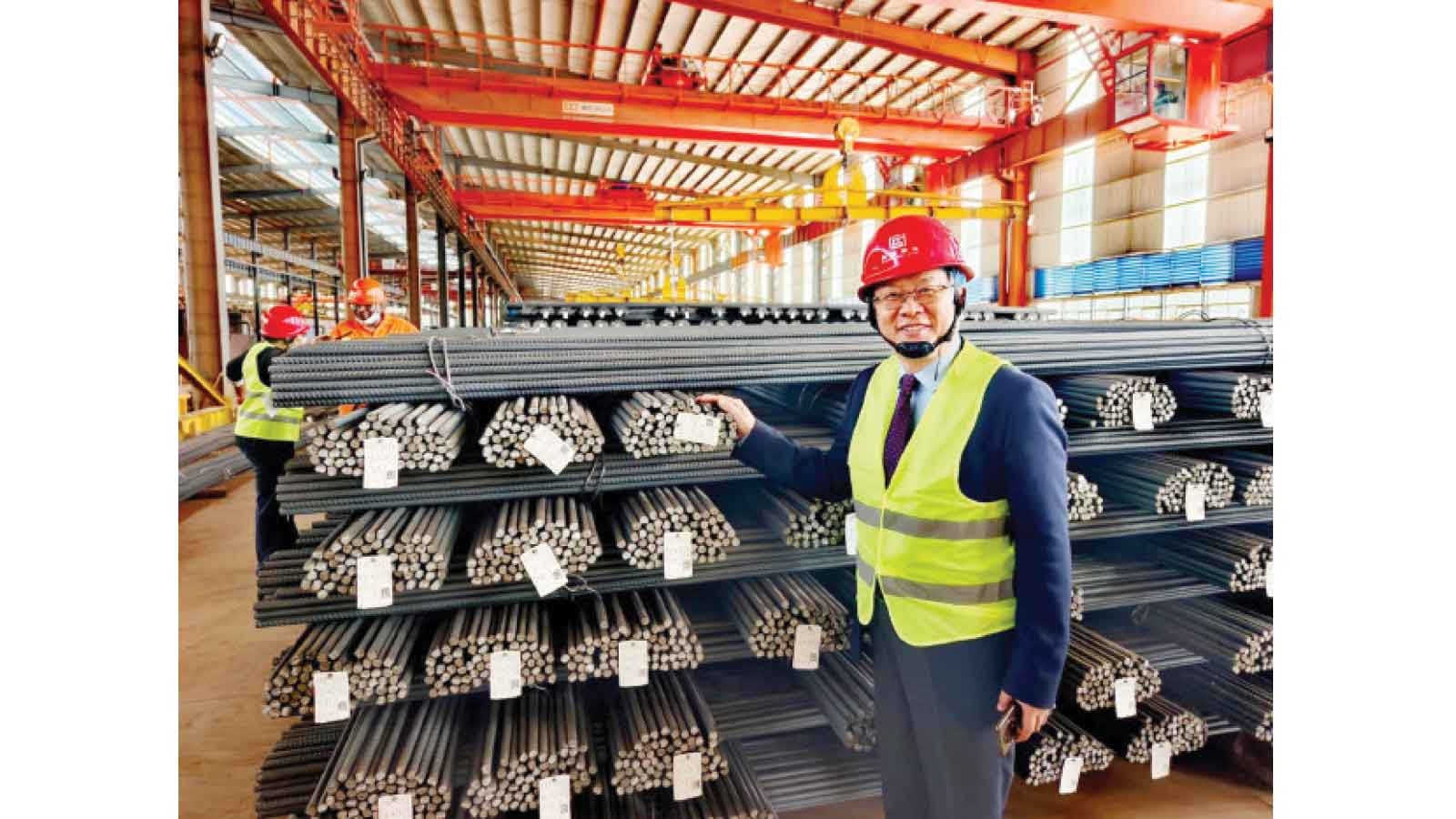
Zimpapers Politics Hub-Kuda Bwititi
LAST week, Chinese Ambassador to Zimbabwe Zhou Ding, Women Affairs, Community, Small and Medium Enterprises Development Minister Monica Mutsvangwa, alongside Members of Parliament led by Cde Webster Shamu, visited the Dinson Iron and Steel Company (DISCO) in Manhize.
Located near Mvuma, the DISCO plant stands tall amidst the fiery glow from furnace stacks.
Over the past four and half years, the Chinese investors have invested heavily into the plant and worked expeditiously to establish the integrated steelworks.
Now, the US$1,5 billion project is up and running, producing steel products and employing over 2 000 people, whilst transforming the communities around Manhize.
The plant stands as a testimony to a transformative geo-political and economic thesis.
This is not just a large factory at work, but it is the sound and sight of a nation’s industrial ambitions being realised.
It is proof that a strategic, long-term partnership between China and Zimbabwe can serve as the primary engine for the Southern African nation’s long-sought industrialisation.
During last Thursday’s tour of the facility, Ambassador Zhou said the visit was not a simple inspection, but a living case study.
“Today’s visit is an opportunity to witness, first-hand, how the partnership between China and Zimbabwe is yielding concrete results and actively contributing to Zimbabwe’s industrialisation,” he said.
The Manhize Steel Plant encapsulates the core narrative of a relationship moving beyond diplomatic rhetoric into tangible, ground-level economic restructuring.
A subsidiary of the global steel giant, Tsingshan Group, the DISCO plant is arguably the most potent symbol of this shift.
Its scale is staggering for the regional context: an integrated steelworks designed for an annual capacity of 1,2 million tonnes in its first phase, with current output already around 600 000 tonnes.
Ambassador Zhou highlighted that 60 percent of this production is exported, directly generating the foreign currency that is the lifeblood of Zimbabwe’s economy.
More critically, the plant’s ambition to become Africa’s largest integrated steel plant points to a strategic intent to reposition Zimbabwe from a raw material exporter into a continental manufacturing hub for a fundamental industrial commodity.
For decades, Zimbabwe’s economy, like many in Africa, has been plagued by the “resource curse”, exporting raw minerals only to import finished goods at a higher cost.
China-Zimbabwe cooperation is often viewed by critics through a narrow lens of resource extraction. The Dinson model seeks to fundamentally rewrite this script.
“I have wished to visit Chinese-invested enterprises…to better understand their operations, their focus on value addition, job creation, and local prosperity,” the Ambassador noted.
The emphasis on “value addition” is key.
DISCO is not merely mining and shipping iron ore, but is processing it domestically into pig iron, steel billets and rolled products.
This vertical integration captures a significantly larger portion of the steel value chain within Zimbabwe’s borders, boosting GDP, creating more sophisticated jobs and fostering ancillary industries.
This aligns perfectly with Zimbabwe’s own National Development Strategy 2 (NDS2) and Vision 2030, which prioritise value-addition and beneficiation.
The link between China’s 15th Five-Year Plan to these Zimbabwean blueprints shows a rare synchronisation of national development agendas.
This synergy provides a framework where Chinese capital and industrial expertise are deployed not in a vacuum, but in direct support of Zimbabwe’s sovereign economic objectives.
The industrial leap Dinson represents is underpinned by a political framework that both sides have carefully constructed.
When President Mnangagwa visited China last year for the September 3 grand celebrations to mark the 80th anniversary of the Chinese People’s War of Resistance Against Japanese Aggression (1931–1945) and the World Anti-Fascist War, relations between the two countries reached new heights.
President Mnangagwa was one of only two African Heads of State at the event, showing how China attaches special attention to its relations with Zimbabwe.
During the same visit, Zimbabwe and China elevated their bilateral ties to an “All Weather Zimbabwe-China Community with a Shared Future” following talks between the two countries’ leaders.
President Xi Jinping proposed a “five-star ironclad” co-operation framework, anchored on five pillars: politics, economy and trade, security, culture and international co-ordination.
The DISCO Steel Plant in Manhize shows that the “All Weather Zimbabwe-China Community with a Shared Future” is not all talk, but is being implemented effectively.
According to Ambassador Zhou, in 2025 alone, approximately 500 Chinese investors registered in Zimbabwe, with planned investments nearing US$2,5 billion.
Crucially, over one-third of this capital is earmarked for manufacturing— a sector that builds productive capacity, not just trading or extractive ventures.
“This is a clear vote of confidence in Zimbabwe’s vision of being open for business,” Ambassador Zhou said, positioning Chinese investment as the leading validator of the Government’s “Zimbabwe is Open for Business” mantra.
In addition to job creation and the massive economic impact of Dinson, what is also impressive is the company’s social responsibility projects that include a US$6 million power grid, a US$8 million dual-lane road, boreholes and renovated schools.
These are not just philanthropy projects, but essential investments in the industrial ecosystem and its social license to operate.
The power grid and road are classic examples of industrial catalysts addressing critical national infrastructure deficits.
Through building them, Dinson not only secures reliable logistics and energy for its own operations, but also upgrades the economic potential of the entire region, enabling other businesses and improving community welfare.
Through the Manhize project, Zimbabwe has also benefited from technology transfer and skills development.
The thousands of jobs created at DISCO are positions in a modern, technologically advanced industry.
The operational knowledge and technical skills absorbed by the local workforce represent a critical transfer of human capital, building the expertise needed to sustain and expand Zimbabwe’s industrial base independently in the future.
The DISCO plant represents a powerful blueprint for South-South cooperation-driven industrialisation.
It combines aligned strategic vision (“All-Weather Community”), patient capital, vertical integration and embedded social development.
It demonstrates a shift from a trading relationship to a co-development partnership focused on building permanent productive capacity within Zimbabwe.
As the furnaces of Manhize light up the Zimbabwean night, they illuminate a path.
They show that the China-Zimbabwe partnership, when focused on mega-projects that anchor entire value chains, has the potential to be the definitive force in rewriting Zimbabwe’s economic story, from recovery to industrial revolution.
Ultimately, the enduring success of the Zimbabwe-China partnership will be measured by its ability to replicate and expand upon the DISCO model, forging a shared future of mutual prosperity for both nations.



 Bongani Ndlovu