admin
admin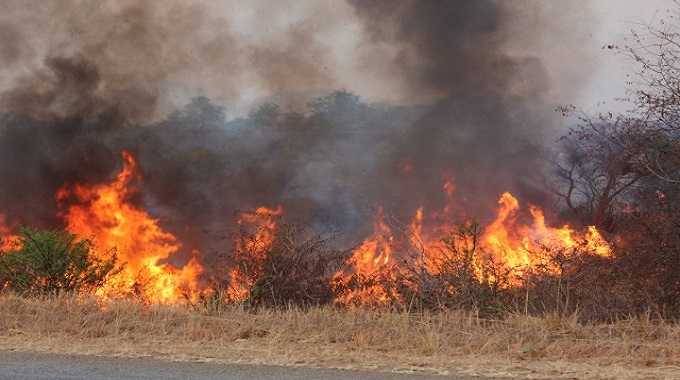
Moffat Mungazi
Post Reporter
THE veld fires menace continues to wreak havoc as 18 people were killed while property worth US$1,5 million was destroyed last year, according to the Environmental Management Agency (EMA) 2022 veld fire report.
This shows a marked increase compared to the previous year as the number of people who lost their lives doubled from eight, while the value of property destroyed surged three-fold from US$370 000.
The 2022 veld fire report by EMA indicates that 1,7 million hectares of land was destroyed last year compared to 1 million hectares in 2021. This translates to a 60 percent increase.
The incidences of veld fires also nearly doubled from the 3 948 of 2021 to 7 511 of last year.
Manicaland and Masvingo provinces recorded the least size of areas burnt, while Mashonaland West and Matabeleland had the largest area burnt respectively.
September and October marked the peak of the fire season as an average of 250 000 hectares was burnt weekly from about 700 fire incidences.
This prompted the the re-evaluation of the National Fire Management Strategy.
In a statement, EMA director general Mr Aaron Chigona said veld fires can be controlled and urged all stakeholders to play their part in line with the revised National Fire Management Strategy of 2022.
“The 2022 fire season was disastrous to the environment and society as 1 753 055,9 hectares of land were destroyed and 18 lives were lost. The current changes in climate and weather variations have led to changes in the fire season for the first time since 2007 when fire regualations were promulgated.
“The fire restriction season will now be reviewed by the Minister of Environment, Tourism and Hospitality Industry on a yearly basis to cater for these climatic changes. The 20022 fire restriction season started on July 31 and ended on November 31 as opposed to the previous years when the fire season ran from July 31 to October 31,” he said.
Mr Chigona called on stakeholders and development partners to join hands in implementing the new concept of model anti-fire villages whose pilot projects were carried out in nine hot spot districts.
Through this initiative, no veld fires were recorded in anti-fire villages.
The model comprises components such environmental education and awareness, training, demonstrations, equipment, livelihood projects and law enforcement.


 Online Reporter