Tinaye Agere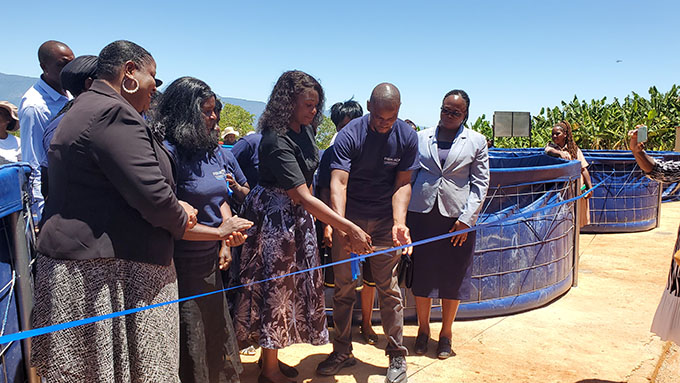
Theseus Shambare in HONDE VALLEY
MASVINGO and Manicaland provinces are set to significantly boost their aquaculture production with the launch of new two state-of-the-art fish fingerling distribution hubs.
The initiative, spearheaded by the Government in partnership with Food and Agriculture Organisation (FAO), aims to produce 2.4 million fingerlings annually.
Per cycle, each hub will enable farmers to produce 342 tonnes.
In an interview with The Sunday Mail on the sidelines of the official launch of Women-led Fish Cooperative fingerling distribution hub at Nyakurimwa village in Honde Valley on Thursday, interim Assistant FAO Representative, Ms Tendai Munyokoveri said the provinces have been selected for their performances due to their greatest number of farmers practising aquaculture.
“The two regions were selected based on a recent aquaculture survey which revealed a significant number of fish farmers.
“Manicaland, in particular, has over 1 800 farmers, making it the region with the highest concentration of fish farmers,” said Ms Munyokoveri.
Each hub, she said, have seven tanks with capacity of 19 cubic meters each, capable of holding 60 000 fingerlings per cycle.
“The fingerlings will be grown to a larger size, between 5g and 20g, to improve survival rates before farmers take them to their respective sites.
“By increasing survival rates to 80 percent to 90 percent, we can make fish farming more profitable and attractive,” said Ms Munyokoveri.
Fisheries and Aquaculture Resources Department (FARD) director, Mr Milton Makumbe said the programme is a follow-up to last year’s US$500 000 Technical Cooperation Programme (TCP) that saw the establishment of fish hatcheries at Henderson, Matobo and Makoholi Research Stations which are under construction.
“These hatcheries are a distance away from farmers, thus, a need for these decentralised state-of-the-art distribution hubs,” said Mr Makumbe.
The Government, under the current Fish for Africa, the Caribbean and the Pacific (FISH4ACP) programme, funded by the European Union and the German Federal Ministry for Economic Cooperation and Development, is targeting to facilitate easy access to quality fingerlings and enable timely feedback on fish growth and production.
“The initiative is expected to contribute to Zimbabwe’s food security, create employment opportunities and promote sustainable aquaculture practices,” said Mr Makumbe.
Feedback: X@TheseusShambare



 Online Reporter