

 admin
admin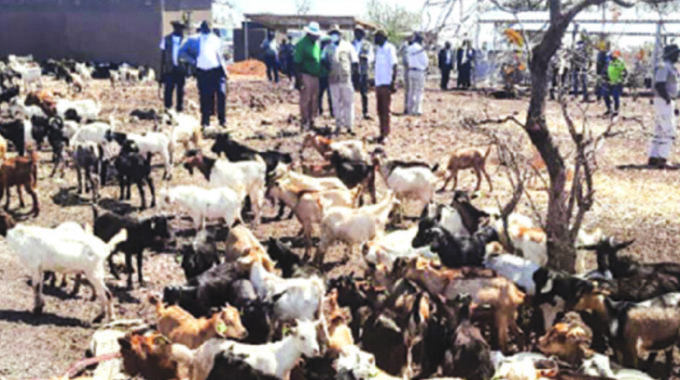
Elton Manguwo
Correspondent
FEEDBACK coming from rural communities that benefited under the Presidential Goat Pass On Scheme is confirming that the programme, just like its predecessors — Pfumvudza/Intwasa, the Presidential Rural Poultry Scheme and Presidential Blitz Tick Grease programme, to name a few, has become an instant hit with beneficiaries who have recorded increased household earnings and improved resilience in the face of challenges.
The programme has so far managed to distribute goats to 4 400 households, which has resulted in a 14 percent growth in production from 4 259 176 in 2021 to 4 891 787 goats in 2022.
The Presidential Goat Pass on Scheme is part of the Government’s timely interventions to accelerate rural development 8.0 in line with the push to achieve an upper middle-income economy by 2030.
The Presidential goat scheme aims to distribute 632 000 goats of improved genetics across the country.
Under the scheme each of the 35 000 villages in the country will receive one buck (male goat) and 17 does for distribution to vulnerable families in every village.
At the launch of the scheme in Chipinge last year, President Mnangagwa said the launch was a significant milestone and key indicator of the Second Republic’s resolve to improve the welfare and livelihoods of Zimbabweans, especially those in the rural areas.
Climate proofing the livestock sub-sector
The country is experiencing climate change, resulting in droughts, floods, pest outbreaks, food shortages and increased vulnerability to shocks.
In response the Government through the Livestock Growth Plan has increased focus on building the resilience of smallholder farmers to climate change through the implementation of climate change adaptation strategies in the agriculture sector.
Goat species with unique browsing potential adapt to a changing climate more readily than other ruminant species.
Lands, Agriculture, Fisheries, Water and Rural Development Minister Dr Anxious Masuka observed that small stock farming was an integral part of building resilience for rural communities in Zimbabwe adding that goats, for example, were an important component of the intervention jigsaw when he delivered his remarks during the launch of Presidential Goat Pass On scheme.
“Goats are naturally easier and cheaper options for livestock production as they can thrive even in difficult conditions where there is less water. Experts propound that goats withstand drought conditions better than cattle and they can thrive on shrubs and need less manpower to tend them,” he said.
“Goats are versatile animals that adapt to a changing climate more readily than the other ruminant species and are well suited to small farming systems and the rise in cattle poverty deaths necessitated the investment in goats,” said Dr Masuka.
Income generation and empowerment
To consolidate its intentions of empowering the rural population, the Government is encouraging the adoption of a business approach to farming and has since invested US$87 million in the launch of the goat scheme that is meant to give the rural population access to a goat herd that can compete.
Goats continue to be an important source of income and nutrition to many poor and marginal farmers around the world and the low initial investment and high turnover rate for goat production are the primary reasons behind the promotion of the goat industry in the country.
The programme is set to pump the country’s goat herd to three million as small stock farming is an integral part of building business for rural communities.
The Agricultural and Rural Development Advisory Services (ARDAS) chief director Professor Obert Jiri recently highlighted that most rural households had received training on aspects of goat rearing, feeding requirements, disease control, best management practices and goat production as a business.
Since the inception of the programme, goats have become one of the major means of employment and income for women, children and the aged people in tropical and subtropical regions of the country. One such beneficiary Ms Lydia Mudawu from Beitbridge said: “Goats are the village banks in our rural areas where we invest our time in looking after them and we consider them an appropriate way of saving money for the future.
I am happy to be witnessing this livestock production scheme where many women and people living with disabilities and those with poor backgrounds are benefiting.”
Rural industrialisation
Rural industrialisation, which hinges on the Second Republic’s devolution policy involves nurturing agro-processing start up enterprises in rural areas through financial and technological support via venture capital funding and Government agencies.
Chief Matibe of Beitbridge commented that this was a good move by the Government, adding that they had seen the economic position of people in the area improving.
“We are now calling upon investors to set up line industries such as abattoirs, leather tanning and meat canning factories at ward centres to create market linkages and employment opportunities for locals in line with the rural industrialisation agenda,” said Chief Matibe.
The Government has been working to increase the adoption of business practices in the agricultural sector and the Presidential Goat Pass On scheme highlights efforts to use less to produce more.
“The animals have become an important source of income as they provide milk, meat, manure, wool and skin therefore keeping them is very important because of the relatively low input requirements and the correspondingly high expected output,” added Chief Matibe.
A communal farmer from the drought prone Mberengwa district in the Midlands province, Mrs Lorreto Zhou, who received a pair of goats said: “This is a timeous intervention from the President and we are happy about this noble programme. Some of us were struggling to restock after drought hit us.”
A youth from Mberengwa district also, Morebrain Ngwenya said the programme would help the villagers in the long run.
“As a young person I want to thank the Government for giving me this opportunity to build my tomorrow. These goats will help change my life,” said Morebrain.
Lands, Agriculture, Fisheries, Water and Rural Development Deputy Minister Mr Davis Marapira said: “Our thrust as Government is to transform rural areas by industrialising them through providing all the basic things that promote a conducive environment for economic development from the grassroots level.”
Export market development
With a growing national herd of four million goats, its successful production can be a viable export option for the resuscitation of the meat export business in Zimbabwe.
According to Trade map the global market demand for goat meat increased from US$6, 9 billion in 2017 to US$8, 6 billion in 2022.
The Agricultural Marketing Authority (AMA) chief executive officer Mr Clever Isaya highlighted that the increase in demand for goat meat and goat products offers small-scale farmers in semi-arid Zimbabwe opportunities for increased market participation.
Recent trends show an increased demand for dairy products from goats, particularly in developed countries where they act as a substitute for dairy products from large ruminants for human dietary needs as eating habits transition to more sustainably developed food.
“The Muslim community demands two million goats annually as they consume them during their major festivities. This simply means the Muslim market demand presents a key market avenue that our farmers can exploit,” said Mr Isaya.



 Online Reporter