Online Reporter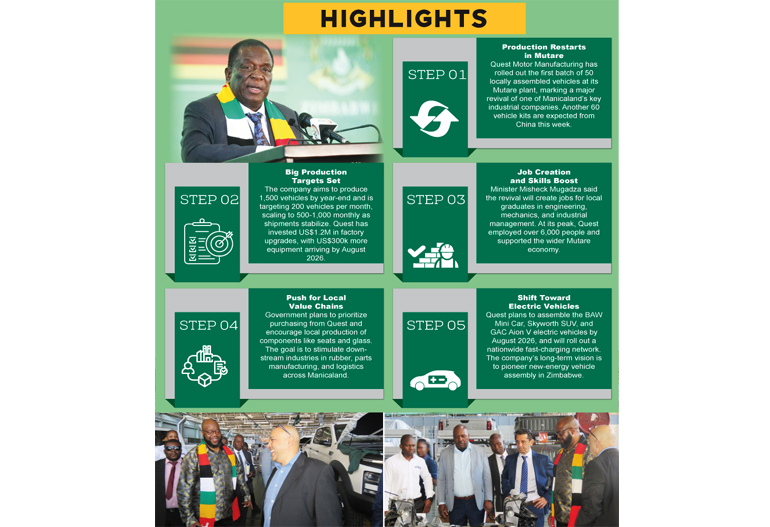
Tendai Gukutikwa
Post Reporter
QUEST Motor Manufacturing has reignited its Mutare plant, rolling out the first batch of 50 locally assembled vehicles in what marks a landmark revival of one of Manicaland’s most iconic industrial giants.
With an additional 60 vehicle kits expected from China this week, the company is firmly back on the road to reclaim its place as a powerhouse in Zimbabwe’s automotive sector.
This development is more than just a corporate milestone—it is a major step in the collective effort by the Government and private sector players to restore Zimbabwe’s manufacturing capacity and position Mutare as a regional hub for vehicle assembly.
For a city that once thrived on industrial activity, the return of Quest Motors signals renewed hope, fresh opportunities, and a tangible contribution to the country’s economic transformation.
Speaking during a tour of the factory on Monday, Minister of State for Manicaland Provincial Affairs and Devolution, Advocate Misheck Mugadza, hailed the rebirth of Quest Motor Manufacturing as a turning point for the province.
He noted that the revival of operations represents the return of industrial activity that once sustained thousands of families in Mutare, and now promises to do so again.
Minister Mugadza emphasised that the company’s renewed operations reflect the broader industrial revival taking place under President Emmerson Mnangagwa’s leadership and the national Vision 2030 agenda.
He described the transformation underway at the Mutare plant as both encouraging and inspiring, pointing out that it will create employment opportunities for young people graduating from local tertiary institutions.
For many of these graduates, Quest Motors offers, not just jobs, but a chance to apply their skills in engineering, mechanics, and industrial management within a proudly Zimbabwean enterprise.
“Quest Motors is one of the oldest companies in Mutare. For many years, it underpinned the whole of Mutare’s economy, as well as that of Manicaland and the country. It once employed over 6 000 people. The whole of Sakubva survived because of Quest Motors Manufacturing. Fortunately, with the coming of the Second Republic, our companies are now coming back to life. Industry is beginning to be what it should be. This workplace has changed completely and we are looking forward to great things,” said Minister Mugadza.
He said the revival of Quest Motors is expected to stimulate downstream industries such as rubber manufacturing, vehicle component production and logistics, bringing wider economic benefits to Manicaland.
Minister Mugadza said Government ministries, departments, agencies and councils in Manicaland will be encouraged to prioritise purchasing locally assembled vehicles to support the growth of the industry.
“With time, we must start getting the seats made here. We can bring in the raw materials and manufacture the seats, the glass and everything here. That is what Quest Motors used to do.
“What we intend to do is to ensure that all schools, Government departments, councils and transport operators purchase their vehicles from this plant,” he said.
Quest Motors general manager, Mr Carl Fernandes, said production has already started at the plant, with this year’s first batch of 50 vehicles currently on the assembly line.
“So between now and the end of this year, we hope to produce 1 500 vehicles. We have been delayed considerably by shipping. We have had some shipping delays out of China into Beira, and then from Beira to Mutare,” said Mr Fernandes, adding that another 60 vehicle kits are already en-route through Beira and will be assembled within the next week.
“Now we have some vehicle kits coming through Beira right now. That is 60 vehicles, and they will be produced in the next week,” he said.
Mr Fernandes said the company is targeting production of 200 vehicles per month, at 50 vehicles per week, over the next six months, with volumes expected to rise significantly as operations stabilise and more kits arrive in the country.
“The kits are coming in tranches of 24 and 48, so we expect about 50 vehicles on average per week. If you divide 1 500 by the next six months, you are looking at an average of about 200 vehicles a month at least,” said Mr Fernandes.
He said production volumes will continue to rise as the company catches up on the delayed shipments and scales up operations.
“Let us say this month we only produce 50, next month we have to produce the balance from the previous month plus the current month. So if we only produce 50, next month we have to produce 350 and so on. There will be times when we will be producing about 500 to 1 000 vehicles a month, but on average towards the end of the year it will be between 200 and 300 vehicles a month,” he said.
Mr Fernandes said the company has invested US$1,2 million in factory upgrades, with another US$300 000 worth of specialised equipment expected by August 2026.
The new equipment includes modern body shop welding guns, high-efficiency standalone paint shop line and five-station rolling road test centre aimed at improving quality standards and increasing production efficiency.
“These upgrades will allow Quest Motor Manufacturing to achieve a production capacity of 5 000 vehicles per month in SKD form,” said Mr Fernandes, adding that the company has also committed US$10 million towards semi-knocked-down kits during the current financial year as part of efforts to expand production.
He said the company’s long-term vision include assembling electric and new-energy vehicles locally.
“Our goal is clear – to pioneer the assembly of new-energy vehicles right here in Zimbabwe,” he said.
Quest Motor Manufacturing is assembling the JAC T9, Foton V9 and the JAC T8.
Mr Fernandes said the company will begin assembling the BAW Mini Car, Skyworth SUV and GAC Aion V electric vehicles by August, while also rolling out a nationwide fast-charging network.
“To support this, we are also rolling out a nationwide fast-charging network,” he said.
Quest Motor Manufacturing director, Mr Tariq Adam said the developments demonstrates that the private sector is responding to the Government’s industrialisation agenda under National Development Strategy (NDS2).
“This is not a distant dream or a PowerPoint plan. This is happening, and it is happening now,” he said.
Quest Motor Manufacturing has also partnered with automotive retail and distribution arm Selected Motors for the distribution of vehicles across the continent.
In an interview, Selected Motors chief executive officer, Mr Justin De Ricquebourg said the partnership with Quest Motor Manufacturing is aimed at rebuilding the automotive manufacturing industry, while creating jobs and developing local skills.
“The idea of vehicles assembled in Zimbabwe and exported across the region is no longer theoretical. It is something we are actively building towards,” he said, adding that the partnership is designed to retain value within the country through local assembly, local distribution and local employment creation as the country reclaims its position on the regional automotive manufacturing map.