Online Reporter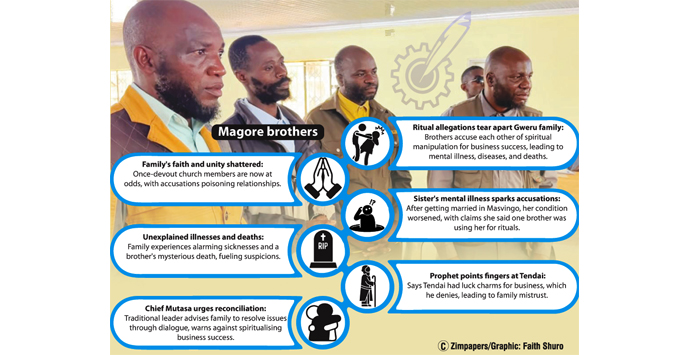
Tendai Gukutikwa
Weekender Reporter
ACCUSATIONS and counter-accusations of ritual practices tied to unexplained deaths and mysterious illnesses have torn apart a once-united Gweru family, dragging the Magore brothers before Chief Mutasa’s community court, amid deepening mistrust.
What was once a closely bonded household, bound together by faith, has now descended into fear, suspicion, and open hostility.
The brothers—devout members of the African Apostolic Church, popularly known as the Mwazha Church—stand divided, accusing one another of inflicting mental illness, strange diseases, and sudden deaths through alleged spiritual manipulation, all in pursuit of business success.
The Magore family told the traditional court that their troubles began after their sister married in Masvingo—a turning point they now believe marked the decline of their fortunes.
Testifying before Chief Mutasa, Simon Magore recounted how the family had lived peacefully until disturbing reports emerged about his sister’s mental condition.
“We all belonged to the same church until our sister got married in Masvingo. We later heard that she had become mentally challenged. Her husband told us she would mutter and shout, asking why her brother, Tendai, wanted to kill her, and claiming he was using her as a luck charm for rituals in his business,” Simon said.
Her condition worsened to the point where her husband’s family could no longer cope, eventually returning her to the Magores.
“Her husband’s family later brought her back to us, and we took her to church for help. Prophets from the church said she was being used by a relative involved in business ventures,” Simon added.
That revelation immediately sowed seeds of suspicion within the family, with fingers pointed at Tendai, one of the brothers engaged in business outside their rural home.
The family’s search for answers did not end there. They later consulted a prophet named Zuva, hoping to uncover the source of their misfortunes.
“Prophet Zuva told us that it was our late father, who had collected luck charms, and that they were buried at our home. The strange paraphernalia was removed,” Simon testified.
However, Simon said the prophet’s revelations went further, shifting blame from their late father to one of the surviving brothers.
“He then asked for Tendai, who by then remained in Gweru as we travelled to Mutasa. We called Tendai, and he came. The prophet told him that he (Tendai) had obtained luck charms for his business in Nyanga, and he denied the allegations,” said Simon.
Simon said the prophet instructed Tendai to bring the alleged charms in December so that they could be destroyed, a process the family believed would bring an end to the suffering they were experiencing.
“In December, when our elder brother got to the healer’s place to witness Tendai’s charms being burnt, he got there late, and the healer told him that he had already destroyed them,” said Simon.
Simon further told the court that the family was never shown any burnt items, a development that only deepened doubts and mistrust among the erstwhile brothers.
Instead of relief, he said, the family’s troubles worsened, with sickness and death striking the family in an alarming way.
“As we speak, people are getting sick like crazy. Another brother opened the door in a moving vehicle, and jumped to his death. A lot of things that are happening are too much to comprehend,” said Simon.
He, however, said their sister’s health improved after being put on medication.
He said the accusations have poisoned relationships among the brothers, turning blood relatives into adversaries who now struggle to sit together or speak openly without tension.
In his defence, Tendai vehemently rejected the allegations, explaining to Chief Mutasa’s court that he never possessed any charms and had not inherited anything from their late father. Tendai said the claims against him were driven by suspicions and jealousy rather than factual evidence.
“The reason why I went back to the prophet was because I had a sick child whom I wanted to get help for, not that I wanted to surrender some charms to destroy. Nothing was burnt as I did not have any charms,” said Tendai.
He said he was struggling to understand why he alone was being singled out when several of his brothers were also engaged in different business activities.
“All of my brothers are into businesses, and I wonder why it is just me they are suspecting. I don’t know why I am the businessman suspected to be behind all these mysterious happenings. I asked my brothers this question, and they simply ignored me,” he told the court.
Tendai said the accusations have alienated him from both his family and the church that once bound them together.
“I also stopped going to church because I realised that my brothers were being waylaid by these prophets. Instead of bringing peace, these prophets are further dividing,” he said.
Chief Mutasa castigated the family for allowing suspicion and jealousy to destroy their unity, reminding them that family bonds should not be sacrificed at the altar of fear and misfortune.
The traditional leader said it was troubling to see brothers accusing each other of such serious allegations without concrete proof.
“You used to love each other, why is there bad blood now? Go back, and sit down as a family. Look into these issues and be united,” said Chief Mutasa.
Chief Mutasa stressed that success in business should not be criminalised or spiritualised, warning the brothers against equating prosperity with wrongdoing.
“Being successful in business is not a sin for Tendai Magore. If one of you works hard and succeeds, it does not mean he is killing for rituals. You must also work hard and stop being jealous,” said Chief Mutasa.
He urged the family to resolve their issues through honest dialogue and reconciliation rather than accusations that could permanently fracture their relationships and family bond.