admin
admin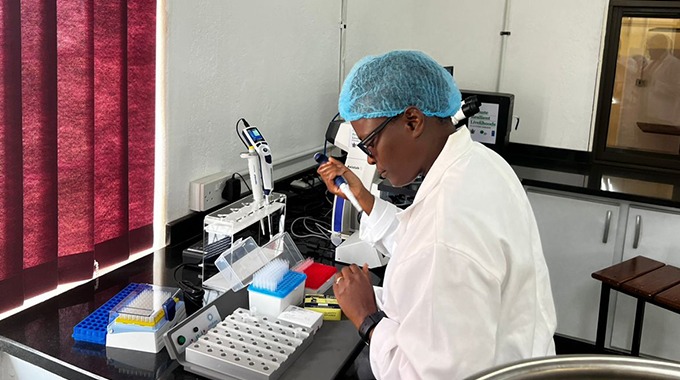
Gibson Mhaka
WITH reports that close to 5,000 cattle succumbed to drought and diseases nationwide last year, with Matabeleland provinces being the most affected, as the El Niño weather phenomenon takes its toll on the national herd, concern has arisen about the need to preserve breeds that are strong, adaptable, and resistant to natural disasters such as drought and diseases.
This has prompted non-governmental organisations and governments to take action to protect the nation’s livestock assets.
Their latest weapon: A gene bank laboratory has been established at the Matopos Research Institute. As the country’s largest semen processing and cryopreservation facility, it is expected to help Zimbabwe preserve its genetic resources, enhance food security, and drive sustainable development in local communities.
The goal is also to maintain a broad genetic base within some of the most commercially important species, as well as to preserve potentially valuable genetic traits found only in rare heritage breeds.
The Semen Processing and Cryo-preservation Centre, a collaborative effort with the United Nations Development Programme (UNDP) under the Green Climate Fund (GCF) project “Building the Climate Resilience of Vulnerable Livelihoods in Southern Zimbabwe,” is the second-biggest in Southern Africa.
Breeds that are being preserved at the Semen Processing and Cryo-preservation Centre comprise adaptable cattle species such as the African Tuli, Nguni, Afrikanda, and Brahman.
The Gene Bank is expected to provide for the harvesting of around 1,500 to 3,000 semen straws per bull per season for artificial insemination. Under natural mating, a bull can only service around 25 to 30 animals per season.
The semen processing and cryopreservation facility was commissioned and handed over to the Government on Saturday last week. The Minister of Lands, Agriculture, Fisheries, Water, and Rural Development, Dr Anxious Masuka, who was the guest of honour said the centre marked a significant milestone in the Government’s efforts to transform the agriculture sector, given the growing food security challenges exacerbated by climate change.
“Agriculture continues to occupy a dominant role in the recovery of our economy and has beforehand contributed up to 20 percent of the country’s GDP; 33 percent to formal employment; 65 percent of raw materials requirement to agro-industries and account for the livelihoods of 67 percent of the population which lives in rural areas as smallholder farmers.
“As such, agriculture is the most direct pathway out of poverty and a pre-condition for economic transformation in pursuit of Vision 2030. This Cryo-preservation Centre at Matopos is one of the five Innovation Platforms established under the GCF project that is co-financed by the Government of Zimbabwe. This initiative resonates with the Government’s commitment to ensuring food security, promoting sustainable agriculture and empowering our farming communities,” he said.
UNDP country representative, Dr Ayodele Odusola, said the semen processing and cryopreservation centre will enable farmers to adapt to the changing environment and enhance agricultural productivity by providing access to climate-resilient cattle breeds.
This will help farmers to improve their livelihoods and contribute to the country’s food security.
“What we are witnessing today is how we can work together to respond to climate issues and promote effective climate action. This will enable farmers to adapt to the environment and enhance agricultural productivity. The gene bank here, with a capacity of three million straws of semen annually, is what we are trying to put in place to ensure that these cattle breeds are climate-resilient. We want to use this to shift cattle rearing from a way of life to a kind of agricultural business so that it can enhance the income of farmers, enabling them to send their children to school and access affordable healthcare,” he said.
Dr Odusola, said the objective is to ensure that these elite cattle bulls are affordable to small-scale farmers through the association, so they can acquire them at a very low cost and contribute to the sustainability of their farming practices.
This will help to improve the livelihoods of small-scale farmers and promote agricultural development in Zimbabwe.
“That is why we are trying to see how we can really ensure that these indigenous elite bulls are widely available to promote agricultural productivity. The objective is to ensure that these bulls are affordable to small-scale farmers through the association, so they can acquire them at a very low cost.
“For sustainability, they might not be free, but they will be very cheap, so farmers can take good care of them. Additionally, the intention is for us to produce these bulls in large quantities so that many farmers can access them, even beyond the Matabeleland region,” said Dr Odusola.
He further said that over US$400 000 had been spent on building the centre.
“The project procured state of the art Semen Processing and cryo-preservation equipment worth US$394 390 from Germany and the Netherlands to equip Matopos Innovation Platform (IP) to be able to support smallholder farmers deal with barriers of accessing climate resilient cattle breeds.
“An additional US$40 000.00 was invested for capacity building of Innovation Platform staff on artificial insemination learning from experiences in Kenya and towards procurement of other key machinery for the supplementary strategies that the Innovation Centre is implementing. This is a total investment of US$434 390,” he said.
Through the facility, semen will be collected from bulls and then checked for quality. If it meets the required specifications, the semen is processed and preserved for future use. The semen is then stored in straws and frozen in liquid nitrogen, allowing it to be preserved for years.
Artificial insemination is the cheapest method the country can adopt to improve the national herd as buying bulls can be expensive for farmers who are not able to buy the best breeds.
Artificial insemination of cattle is a technique by which semen from a bull is artificially introduced into a cow’s reproductive tract for the purpose of conception.



 Online Reporter