Online Reporter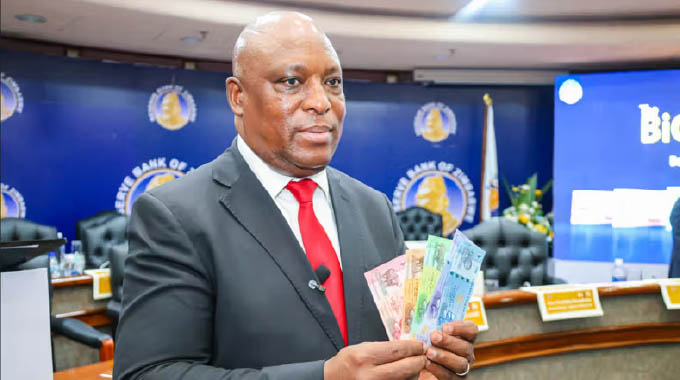
Nelson Gahadza [email protected]
ZIMBABWE remains on course to achieve its 5 percent projected economic growth for 2026, driven by strong performance in agriculture, mining, manufacturing and services and reinforced by improved foreign currency availability, exchange-rate stability, subdued inflation and rising reserves.
This year’s forecast growth rate remains exceptionally high, although it represents a moderation from the expansion seen in 2025, compared to the robust 7,5 percent to 8,3 percent growth recorded in 2025.
The strong performance has manifested in a 47,8 percent surge in foreign currency receipts in the first half of the year to US$10,72 billion, which resulted in usable foreign currency reserves rising to US$1,7 billion by the end of July, equivalent to 1,7 months of import cover.
This outturn has provided the economy with greater capacity to meet external payment obligations and supported stability in the foreign exchange market.
Presenting the 2026 Mid-Term Monetary Policy Review Statement in Harare yesterday, Reserve Bank of Zimbabwe Governor Dr John Mushayavanhu said the economy had maintained strong momentum during the first half of the year, placing the country on course to meet the 5 percent growth target.
He said estimated Gross Domestic Product (GDP) figures for the first quarter showed year-on-year growth of 6,8 percent, significantly higher than the 4,4 percent recorded during the corresponding period last year.
“The growth benefitted from improved availability of foreign exchange in the Willing-Buyer/Willing-Seller interbank market, as well as reliable power supply that has supported increased productivity across all sectors of the economy,” Dr Mushayavanhu said.
The central bank chief added that signals from the Composite Indicator of Economic Activity (CIEA) point to continued robust economic activity in June 2026, following a seasonal downturn in January 2026.
The strong performance has been supported by improved macroeconomic conditions, particularly the availability of foreign currency, which has eased pressure on businesses and supported production across key sectors.
Foreign currency receipts rose from US$7,25 billion in the first half of 2025 to US$10,72 billion in the six months to June this year, representing a 47,8 percent increase.
The inflows exceeded cumulative foreign currency payments of US$7,30 billion during the period, resulting in a stronger external position and allowing the central bank to build reserves while supporting the functioning of the interbank foreign exchange market.
Export proceeds were the largest contributor to the increase, rising 90,7 percent to US$7,53 billion from US$3,95 billion during the same period last year.
The export sector accounted for 70,3 percent of total foreign currency receipts during the review period, highlighting its continued importance to Zimbabwe’s economic performance.
Mining led the export recovery, with receipts rising 121,3 percent to US$6,21 billion from US$2,81 billion.Gold remained the largest contributor to inflows, with receipts increasing by 176 percent to US$3,82 billion from US$1,38 billion.
Platinum receipts rose 82,8 percent to US$1,46 billion, while lithium ore and concentrates increased 78,2 percent to US$382,4 million. Chrome ore and ferrochrome receipts also rose 60,1 percent to US$239,5 million.
Tobacco earnings increased 23,5 percent to US$967,6 million from US$783,7 million, further strengthening the country’s foreign exchange position.
The export performance was complemented by a sharp increase in diaspora remittances, which rose 41,4 percent to US$1,55 billion from US$1,09 billion.
“Remittances accounted for 14,4 percent of total foreign currency receipts, providing another important source of hard currency at a time when Zimbabwe continues to manage its transition towards greater monetary and exchange-rate stability,” Dr Mushayavanhu said.
He said the improvement in foreign currency inflows has translated into stronger reserves, with usable foreign currency reserves reaching US$1,7 billion by the end of July, equivalent to approximately 1,7 months of import cover.
“Reflecting the increased foreign exchange inflows, reserves increased to US$1,7 billion by the end of July 2026, equivalent to approximately 1,7 months of import cover,” Dr Mushayavanhu said.
He said the reserves, which were also supported by gold purchases and in-kind royalties, had strengthened the RBZ’s capacity to intervene in the foreign exchange market and ensure that legitimate external payments were met.
Economist Eddie Cross said the increase in reserves was encouraging, although Zimbabwe still needed to build a larger buffer before moving towards greater exchange-rate flexibility.
“The issue of reserves of currency and gold is critical. We need at least three months cover; six is even better before we can open up the market and allow a free trade in currency. We are slowly getting there,” Mr Cross said.
Harare-based Economist Mr Persistence Gwanyanya said the increase in reserves represented substantial progress, particularly when compared with the level recorded when the Zimbabwe Gold (ZiG) currency was introduced.
“The increase of foreign reserves to US$1,7 billion from US$276 million at the introduction of the ZiG represents a substantial accumulation. This trajectory reflects strong real sector growth and sustained foreign currency inflows over the corresponding period,” Mr Gwanyanya said.
He said the reserve accumulation was also strengthening confidence in ZiG convertibility, which was critical to the currency’s market acceptance and credibility.
“At current levels, these reserves underpin confidence in ZiG convertibility, a critical determinant of its market acceptability and overall currency credibility,” he said.
The stronger foreign currency position has also supported exchange-rate stability. During the first half of the year, the ZiG traded within a relatively narrow range of between ZiG25 and ZiG27 against the United States dollar, while the parallel market premium averaged around 15 percent.
Mr Gwanyanya said improved liquidity in the interbank market had helped ease foreign exchange pressures.
“The convertibility of the ZiG is evidenced by enhanced foreign exchange liquidity in the interbank market, which has adequately met market demand,” he said.
Mr Gwanyanya said the anticipated rollout of electronic trading platforms could further deepen market accessibility and strengthen the interbank market as the principal avenue for currency trading.
The improvement in the external position was also reflected in the current account, which strengthened to an estimated surplus of US$1,3 billion during the first half of 2026, from US$248 million in the corresponding period last year.
However, rising foreign currency receipts have also been accompanied by increased demand for foreign exchange, with authorised dealer payments increasing 44,9 percent to US$7,3 billion during the first six months of the year.
Trade-related payments accounted for 81 percent of total payments, with US$2,7 billion, or 37 percent, directed towards raw materials, intermediate goods and capital goods.
Meanwhile, the improved external position has been accompanied by significant gains in price stability.
Annual ZiG inflation remained in single digits during the first seven months of the year, with annual inflation declining to 3,2 percent in July from 4,7 percent in June.
Dr Mushayavanhu said annual ZiG inflation was projected to remain low and stable at around 5 percent by year-end, within the Southern African Development Community’s macroeconomic convergence target of between 3 and 7 percent.
“Annual ZiG inflation is projected to remain low and stable, averaging about 5 percent and within the SADC macroeconomic convergence target of 3-7 percent by the end of the year,” he said.
“Month-on-month inflation is projected to remain below 1 percent, barring any significant domestic and external shocks.”
The improved inflation outlook has allowed the central bank to begin easing monetary conditions, with the Bank Policy Rate reduced from 35 percent to 30 percent per annum.
The interest rate on the Targeted Finance Facility was also reduced from 20 percent to 15 percent, bringing the cost of targeted funding more in line with the revised policy rate.
Dr Mushayavanhu said the RBZ would nevertheless remain cautious to ensure that the gains made in inflation and exchange-rate stability were not reversed.
“To preserve these gains, the RBZ will maintain its current prudent monetary policy stance and the Bank will stay the course into the second half of the year,” he said.
The central bank will continue using Non-Negotiable Certificates of Deposit to manage domestic liquidity and money supply, while maintaining the 70 percent foreign currency retention threshold as part of efforts to support reserve accumulation and exchange-rate stability.
Mr Gwanyanya said the combination of low inflation, exchange-rate stability and rising reserves pointed to an emerging structural shift in Zimbabwe’s macroeconomic environment.
“Average ZiG inflation of 4,2 percent over the seven-month period ending in July, coupled with parallel market premiums contained within a 15 percent band, suggests a structural shift in market focus.
“The primary concern has transitioned from mitigating price and currency volatility to ensuring the sustainability of this stability,” he said.
Mr Gwanyanya said the gains reflected sustained real-sector growth and ongoing ease-of-doing-business reforms, but cautioned that Zimbabwe needed to institutionalise confidence-building measures to protect the progress made.
Despite the positive outlook, the RBZ remains alert to potential risks, including volatile international commodity prices, adverse weather conditions and external geopolitical developments that could affect inflation, foreign currency receipts and economic activity.
Dr Mushayavanhu said monetary policy would therefore remain flexible and responsive to emerging risks.
“Price, currency and exchange rate stability are firmly and durably anchored,” he said.