Online Reporter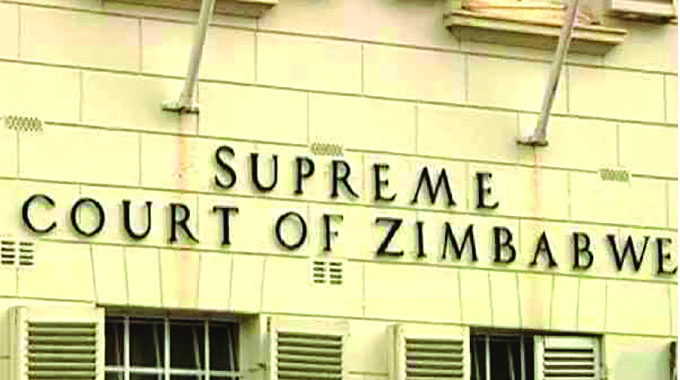
Fidelis Munyoro, Harare Bureau
THE Supreme Court has ruled that National Employment Councils (NECs) no longer have authority to handle certain labour disputes after the Labour Amendment Act No. 11 of 2023 came into effect in July 2023.
The ruling came from a case involving Richards and Company (Pvt) Ltd in Masvingo and an employee, Constantine Nyenya.
An arbitrator from the NEC had ordered the reinstatement or compensation of the employee after dismissal.
But Richards and Company argued that the arbitrator had no legal power because the law had replaced voluntary NECs with statutory employment councils.
The Supreme Court agreed, saying because the case was decided after the new law took effect, the NEC no longer had jurisdiction.
This made the arbitrator’s decision invalid.
The judges — comprising Justices Antonia Guvava, Lavander Makoni and Samuel Kudya — stressed that disputes must now be handled strictly within the new legal framework, adding that time limits and proper procedures must be followed.
In its ruling, the court decreed: “It is ordered by consent that the appeal be and is hereby allowed with no order as to costs. The judgment of the court a quo under LC/MD/24 dated 27 June 2024, as corrected on 16 August 2024, be and is hereby set aside and substituted with . . . The appeal for review be and is hereby dismissed with no order as to cost.’”
This landmark decision makes it clear that the Labour Amendment Act has effectively ended the role of voluntary NECs, reshaping how workplace disputes are resolved.
The case first played out at the Labour Court, where a significant jurisdictional challenge was addressed in June last year.
The dispute involved Richards and Company (applicant), Constantine Nyenya (first respondent) and Mr GM Chibaya (second respondent).
The conflict emerged after the Local Joint Committee overturned Richards and Company’s decision to dismiss an employee, ordering the employee’s reinstatement or compensation.
Notably, this ruling was made before the enactment of the Labour Amendment Act No. 11 of 2023, which came into force on July 14, 2023.
The matter escalated to the Negotiating Committee in March 2023, with a final determination issued by arbitrator Mr GM Chibaya in April 2024.
However, Richards and Company challenged the validity of Mr Chibaya’s authority, arguing that the Labour Amendment Act had abolished the voluntary system of NECs and replaced them with statutory employment councils.
Richards and Company contended that Mr Chibaya, a designated agent under the now-defunct voluntary system, lacked the authority to adjudicate the dispute following the legislative changes.
It also argued that the determination, issued nearly a year after the dispute arose, was invalid as it exceeded statutory time limits.

In response, Nyenya, represented by Advocate Caleb Mucheche, defended the referral of the matter to Mr Chibaya, asserting that the amendment did not retroactively revoke the status of previously registered employment councils without formal deregistration.
The court, however, rejected Richards and Company’s complaint about how Nyenya submitted his response.
More importantly, it found that Mr Chibaya had no jurisdiction to handle the case.
The Labour Amendment Act had clearly stipulated time limits and statutory frameworks, effectively nullifying the authority of voluntary employment councils.
Because the dispute was initiated before the amendment but determined after it, and no legal provision allowed for continuity under the old regime, the court declared Mr Chibaya’s determination null and void.
The judgment shows how important legal authority and meeting deadlines are in labour disputes.
By ruling that Mr Chibaya’s actions were ultra vires (beyond legal power), the court has sent a clear message about the need for strict compliance with legislative changes.
The ruling also highlights the broader implications of the Labour Amendment Act No. 11 of 2023, which seeks to modernise the country’s labour laws by streamlining dispute resolution mechanisms.