peter
peter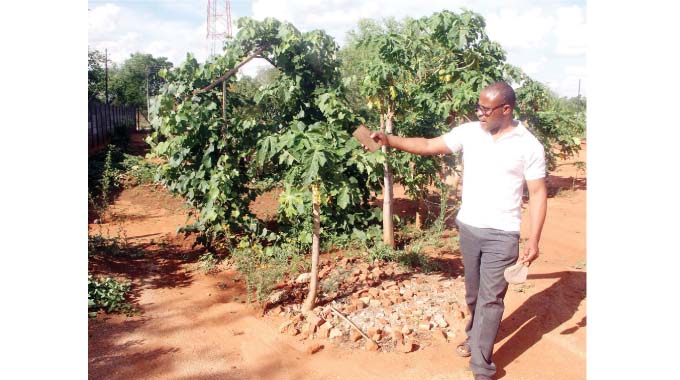
Robin Muchetu, Senior Reporter
BEFORE the fall of man, the Bible tells us that there was once a garden of Eden where there were all fruit trees that man can think of.
The collection of the trees was natural, it was God himself who had commanded that there be such trees.
Today we can only visualise or is it imagine – having a mental picture of what the Garden of Eden looked like.
In Bulawayo something closer to that seems to be materialising in the leafy suburb of Waterford.
Except that the area is a residential stand, what gives the Eden picturesque is the wide variety of well tendered fruit trees from where “Adam” and the human family were supposed to pick fruits without breaking a drop of sweat.
The fruits are good diet and dieticians are quite particular about a person having a fruit or two every day.
But in the age long after the Garden of Eden where everything was natural, some of the fruits we eat today are genetically modified.
This has motivated Mr Abel Ndlovu, a primary school teacher at a private school in Bulawayo to create an imitation of the Garden of Eden that we hear of in the Bible where from the outside one cannot even see the house because of indigenous and exotic trees in his yard.
Mr Ndlovu fell ill and was diagnosed with high blood pressure and was immediately initiated on medication that he was to take religiously in order to save his life.
This, however, did not sit well with him as he could not stomach being on medication and decided to act on his health.
“My health condition is a product of health reform and diet.
I looked at how best I could manage my system and I saw that diet was the best.
I did not want to be troubled after missing a dose of medication.
I realised that 95 percent of the health conditions that people have are a result of what they eat.
If you manage what you eat, then you cut off other health conditions.
I realised there is power in diet, this is when I decided to set up a cultural village in the city to educate people on how to grow our traditional fruits and foods and introduce our traditional preservatives and also teach them on the preparation of this food too,” he told the Sunday News during a tour of his project.
The quest to get land from the city council to set his project failed but that did nothing to stop his pursuits.
It prompted him to go and secure land from a private resident on the outskirts of town in Waterford suburb.
He wanted to start a cultural centre, where he grows traditional foods that can be accessed by citizens but land was a challenge and opted for an orchard instead.
“I got this piece of land in 2018 but I had already given up on the idea of a culture centre.
So, when I got here and had my own space, I decided to start growing my own fruits as I wanted to bring the village to the city.
That’s why you find that this orchard has over 50 fruit varieties both exotic and indigenous.
I want to be able to enjoy our local fruit while in the city, not to wait to enjoy it when I visit the countryside,” said Mr Ndlovu.
He added: “I started with a grafted garden then had a hardy garden on the other side.
We also have a back to Eden Garden which has non-grafted indigenous non-grafted exotic trees.
I use my property as a pilot centre as our region is importing a lot of these fruits yet we can get them locally if we grow our own.
“This then gave birth to our nursery where we now sell fruit trees, I also now offer land preparation tips, I have a guide on how they must prepare their land.
For everyone that buys trees from us, I add them to a WhatsApp group when I assist them to tend to their trees and give advice where there are challenges and just have a follow up.”.
Mr Ndlovu says the whole idea behind his orchard is to promote healthy living through eating healthy organic fruits and vegetables.
“We avoid treating our fruits with chemicals as we can intoxicate the fruit. Out of interest, our neighbours started enquiring about our trees and if we sell them.
Then I was not selling, I just wanted to promote the idea of eating healthy food produced at home and I gave all my neighbours fruit trees to grow in their homes.
Some have done it so well and I’m happy they appreciate the idea,” he said.
He lamented that while people have land around their homes, they do not grow fruit trees but rather buy imported fruits that are genetically modified.
“Most of the time people fill up their shopping trolleys with fruits in shops that are not organic and that made me want to grow my own fruits that are organic.
Now I have a pilot project where I created a four in one stone fruit which includes, apricot, nectarine, peach and a plum.
Through my research I have discovered that there are more health or medicinal benefits in fruit trees than nutritional benefits.
Fruit trees from as far as Binga are also available at the orchard that have both medicinal and nutritional value,” he said.
He noted that some of the fruit trees that he grows were a result of enquiries from diasporans.
“I get to hear about some of the fruits from people living in the diaspora.
I had a visitor who relocated to Zimbabwe from California after a 34 year stay.
They were looking for fruit trees to plant and were referred to me.
The couple then asked to capture my project and shared it on their YouTube channel so that is how some people abroad got to know about us and these people now contact us and we assist them in setting up their own orchards on the pieces of land they had and were idle.
We have inspired people to set up their own orchards at home.
I have made contact with someone who has an acre of land and wants to replicate what I have now,” he said.
Mr Ndlovu, who is a special needs teacher by training said some of his fruits and herbs were for the community.
“If you visit the countryside you return with a bag of fruits that they will have given you for free so I am also doing the same as I have planted fruit trees that are for the community to enjoy.
Some of the trees are on the outside of our yard so that whoever feels they want fruit, they can pick and enjoy.
I believe there may be an orphan out there who will one day go to school without any food, so these fruits are going to benefit them too,” he said.
Mr Ndlovu said the area was, however, prone to frost and they have lost some fruit trees to it.
He travels around and also networks with others in Zimbabwe where he sources some of his fruit trees.
His intention is to grow mainly food or herb even for decorative purposes and his driveway is lined with paw-paw trees only.
Mr Ndlovu said 80 percent of the job is done by him and his wife.
He said when he started the project, he was being assisted by his neighbour who provided water for his trees for free but now, he harnesses rain water for use to water the garden assisted by a borehole.
His family has been supportive with his young son assisting on the technology side.
“We launched our YouTube channel in September this year and it was him that set up the channel, he took the videos, edited and uploaded them on the channel.
He has also started his own herbal garden and I can see that he has green fingers,” he said.
The family also have free range chickens that they keep versus the broiler chickens.
However, the space remains small at his Waterford residence as he wants to have a herbal forest to grow all medicinal trees and herbs.
Mr Ndlovu said they are able to enjoy fruits throughout the year and can enjoy a minimum of three fruits daily with his family. — @NyembeziMu



 Online Reporter