Online Reporter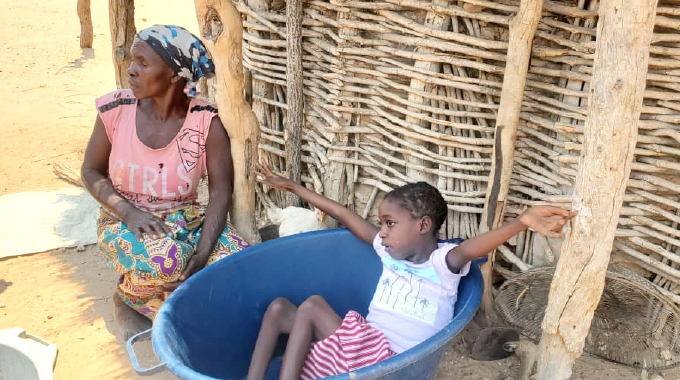
Theseus Shambare, Features Writer
THE December sun beats down relentlessly on Siansundu Village in Binga District, Matabeleland North Province, casting harsh shadows over the cracked earth.
The rains are yet to come.
For 13-year-old Bwime Siyamuwaka, the heat is only one of the countless barriers that define her world.
She lies in a faded blue plastic dish, her small frame rigid yet alert, brown eyes following a sky that seems impossibly far.
She cannot walk. She cannot speak.
She cannot leave the dish that has become her entire universe.
Her grandmother, Gogo Ester Siyamuwaka (70), moves slowly but tirelessly.
She drags the dish across the yard, shields her granddaughter from the harsh December sun, fans her with an old calendar page and becomes Bwime’s voice, feet and shield.
“Sometimes I think my back will break before she can walk,” Gogo Siyamuwaka says softly.
“But I can’t stop. Who else will carry her?”
As the world observed International Day of Persons with Disabilities (IDPD) last Wednesday, under the theme, “Fostering Disability-Inclusive Societies for Advancing Social Progress,” Bwime’s struggle is a living reminder of why inclusion and support cannot wait.
Siansundu is a dry, isolated corner of Binga District, where poverty is a constant companion.
The sandy soils yield little from finger millet and goats and chickens — once a source of food and income — have vanished.
Most households survive on donor food aid, according to the 2025 Zimbabwe Livelihoods Assessment Committee Report.
For caregivers like Gogo Siyamuwaka, daily survival leaves little room to advocate for services or support for children with disabilities.
Bwime’s mother works in Bulawayo, sending what little she can, but the funds barely cover soap, salt and mealie-meal.
Gogo Siyamuwaka’s hands are calloused, not from ploughing, but from dragging the dish across stones and dust, inch by aching inch.
“She likes it when the wind blows,” she said, lifting the dish from under a tree.
“Then she looks free — for a moment, she forgets she can’t walk.”
Even simple milestones of adolescence are daunting.
There is no disability-friendly school nearby.
No nurses trained to handle her needs. No peer support to guide her through puberty.
“She is growing, yes,” Gogo Siyamuwaka whispers.
“But I don’t know how to help her when her body changes. We have no pads, no privacy, no guidance.”
Unicef reports that one in three girls with disabilities in rural Zimbabwe lacks access to basic sexual and reproductive health services.
In districts like Binga, isolation is compounded by distance, poverty and infrastructure barriers.
For Bwime, the arrival of inclusive toilets through the Zimbabwe Red Cross Society’s Climate Smart Resilience Project has been a small but profound victory.
Under this initiative, she became one of the 50 beneficiaries provided with disability-friendly sanitation.
Piped water and training on sexual and reproductive health were also introduced, offering a glimmer of dignity and protection.
“Before, I carried her to the bush.
“Now, I can take her to the toilet without shame. But I still carry her. The dish doesn’t climb steps,” Gogo Siyamuwaka said.
Ms Spiwe Sibanda, district field officer for the CSR Project, said: “For children like Bwime, accessing proper sanitation is a critical first step towards inclusion. But mobility remains the biggest barrier to participation and independence.”
Zimbabwe has made strides on paper.
The National Disability Policy, Persons with Disabilities Act, and NDS2 outline a framework for inclusion, accessibility and empowerment.
On this International Day of Persons with Disabilities, Signs of Hope Trust (SoHT) director Ms Samantha Sibanda, called on the Government to turn policy into tangible support.
“Progress is only meaningful when it reaches people like Bwime.
“A disability-inclusive society benefits everyone. When persons with disabilities participate fully, communities grow stronger, workplaces become more innovative, and nations progress faster,” Ms Sibanda said.
SoHT emphasised three urgent priorities: reducing the economic burden of disability, funding disability programmes through a Disability Levy and criminalising disability-related discrimination.
Despite these efforts, Bwime remains confined.
A wheelchair — costing US$150 to US$200 — could transform her life.
It could allow her to feel the wind on her face, join community activities, attend school and give her grandmother a chance to rest.
For a child who has known only immobility, the difference between a plastic dish and a wheelchair is not luxury — it is dignity, independence and hope.
“Sometimes I dream she could run, laugh, play,” Gogo Siyamuwaka said, hugging her granddaughter.
“I know it’s impossible without help. But maybe someone will remember her and make that dream real.”
Across Africa, inclusion remains a challenge.
Purple Signs Global, a continental disability advocacy organisation, marked IDPD by announcing 2026 initiatives including the Africa Disability Film Festival, the Africa Banking, Insurance, Investment and Disability Summit and Awards and the Africa Travel and Tourism Summit and Awards.
These initiatives aim to challenge stigma, promote investment and expand opportunities for persons with disabilities across Africa.
Mr Dominic Tapfuma, the organisation’s leader and a UN International Telecommunications union award recipient, notes that over 188 million Africans live with disabilities, many of whom continue to face barriers linked to stigma, inaccessibility and social exclusion.
Bwime’s story is a personal reflection of a global reality: millions of children in Zimbabwe and across Africa are invisible, underserved and isolated.
Her silent struggle, witnessed only by her grandmother, is a call to action.
Local Red Cross branches and disability support organisations are accepting donations to provide wheelchairs and assistive devices for children like Bwime.
Each contribution can turn a blue plastic dish into a chariot of hope, giving a child freedom, dignity and the chance to participate fully in life.
In the fading light of Binga, Gogo Siyamuwaka tucks a thin blanket over her granddaughter.
Bwime hums softly, eyes following the flicker of firelight.
Her world is small, but with compassion and action, it could expand beyond the boundaries of dust, heat, and silence.
Sometimes, a single act of kindness is enough to change a life — and restore humanity.