Online Reporter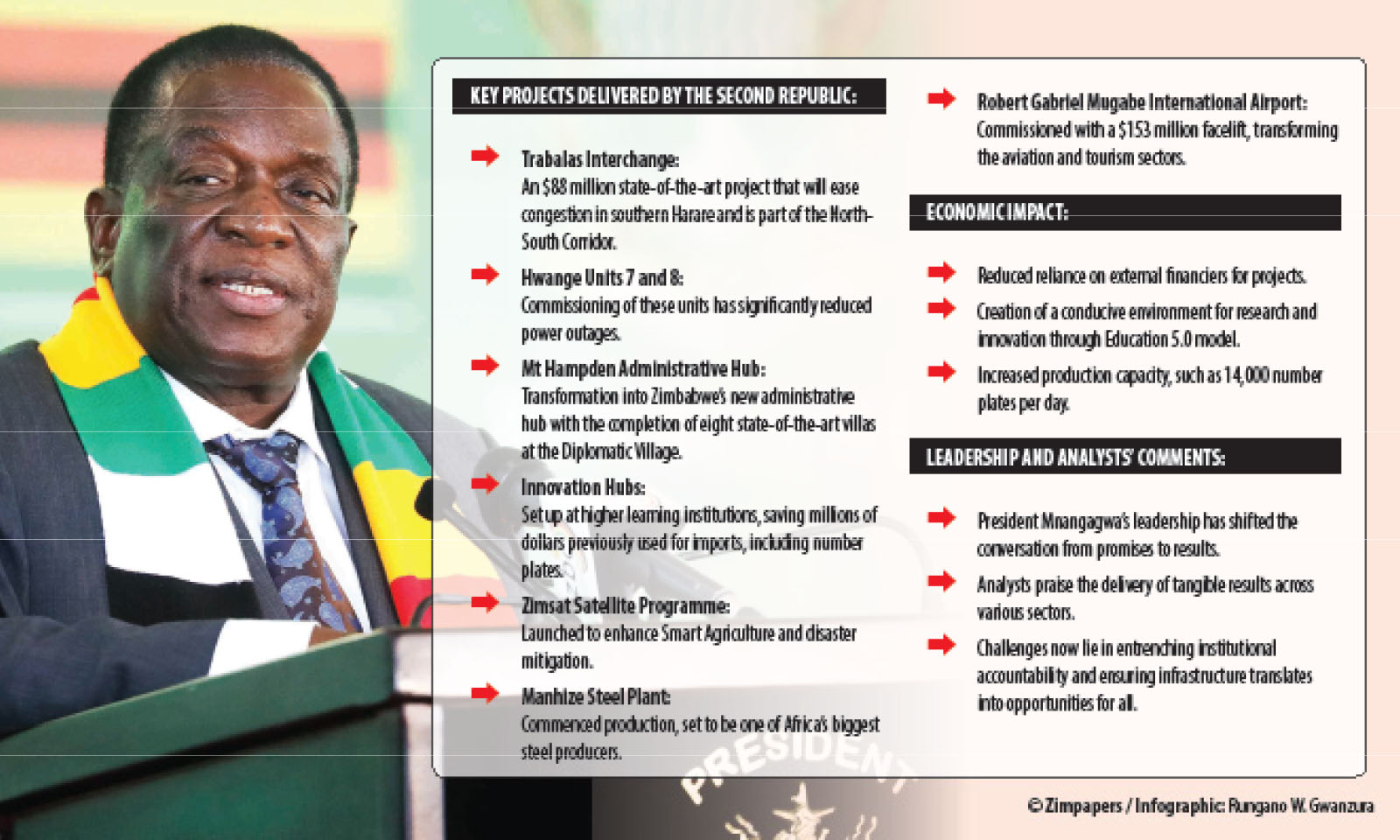
Wallace Ruzvidzo
Herald Reporter
The US$88 million state-of-the-art Trabablas Interchange to be commissioned this Friday is the latest testament to President Mnangagwa’s action-oriented leadership, as he continues to deliver on his promises.
Over the years, the Second Republic has ushered life-changing projects and even seen through the completion and progression of some that had been stagnant before the dawn of the New Dispensation.
The Trabablas Interchange is a key component of the North-South Corridor — a major regional trade route linking Zimbabwe with SADC neighbours and the rest of the continent at large.
Among the many life-changing projects commissioned by the Second Republic are the Hwange Units 7 and 8.
The commissioning of these two units have seen power outages decreasing significantly.
The transformation of Mt Hampden into Zimbabwe’s new administrative hub is also progressing well, with the recent completion of eight state-of-the-art villas at the Diplomatic Village.
The villas embody the Government’s dedication to top-notch urban infrastructure, complementing the nearby new Parliament Building.
They are hailed as a beacon of renewal and visionary leadership, reflecting a master plan for a more streamlined urban landscape.
With ongoing construction on subsequent phases, these inaugural eight villas offer a glimpse into Zimbabwe’s promising urban future — sleek, well-organised and full of potential.
Innovation hubs set up at higher learning institutions including the University of Zimbabwe, Harare Institute of Technology and Zimbabwe Defence University, are also among the life-changing projects delivered by the Second Republic.
Some of these hubs have seen the country save millions of US dollars that would previously be used to import goods and services, including number plates. Because of the number plate plant at the University of Zimbabwe’s innovation hub, the country has cleared the once insurmountable backlog.
The country now can supply number plates to other countries in the region, as it boasts a production capacity of 14 000 per day.
In addition, Zimsat, a Zimbabwe satellite programme, was launched in a bid to enhance Smart Agriculture and disaster mitigation.
Government has created a conducive environment for research and innovation through the Education 5.0 model which has seen other initiatives, including the refurbishing and readying of the Oxygen and Nitrogen Gases Plant, which has significantly reduced the importation of gas.
The Manhize steel plant, set to be one of the biggest steel producers in Africa, has also commenced production, aiding the country’s economic development.
Once fully operational the plant will be among Africa’s biggest integrated steelworks.

The US$1,5 billion steel plant commenced production last year in July, starting with pig iron prior to adding steel billets at the tail end of last year.
The steel plant also boasts a 50MW power plant which feeds excess power into the national grid as the plant only consumes 28MW.
President Mnangagwa also commissioned the new-look US$153 million Robert Gabriel Mugabe International Airport, which has brought massive transformation in the aviation and tourism sectors.
The airport’s commissioning is further evidence that the Second Republic is walking the talk in modernising and industrialising the country for the achievement of Vision 2030.
The air transport system is a critical cog in the country’s re-engagement and engagement thrust.
Apart from that, roads in the country are also being rehabilitated, and in all the projects Zimbabwe is not relying on external financiers but is rather using its resources.
Analysts have noted that the Second Republic continues to meet the people’s aspirations.
Political commentator Mr Dereck Goto yesterday said President Mnangagwa had shifted the conversation from promises to results.
“When President Mnangagwa took office in 2017, he inherited a nation in urgent need of renewal — economically, institutionally and psychologically.
“What has unfolded since is not merely a catalogue of infrastructure projects, but the emergence of a developmental State grounded in delivery, pragmatism and a recalibrated social contract.
“So, has President Mnangagwa walked his talk? The facts increasingly say yes.
“This is not about political theatre — it is about realigning national priorities with delivery and foresight,” he said.
The foundation, added Mr Goto, had been laid by the President.
“More recently, the Trabablas Interchange has redefined urban mobility in southern Harare, showcasing world-class engineering led by local companies and easing perennial congestion.
“But these are just a few threads in a broader national tapestry.
“The challenge now lies in entrenching institutional accountability, safeguarding momentum and ensuring that infrastructure translates into opportunity —particularly for the youth, women and rural populations,” he said.
Political analyst Mr Kudzai Mutisi said President Mnangagwa had exhibited great leadership as he was delivering tangible results across the board.
“We expect President @edmnangagwa to officially open Trabablas Interchange this week on Friday.
“This is one of the numerous mega-projects implemented by ED’s Government,” he said on his X handle.