admin
admin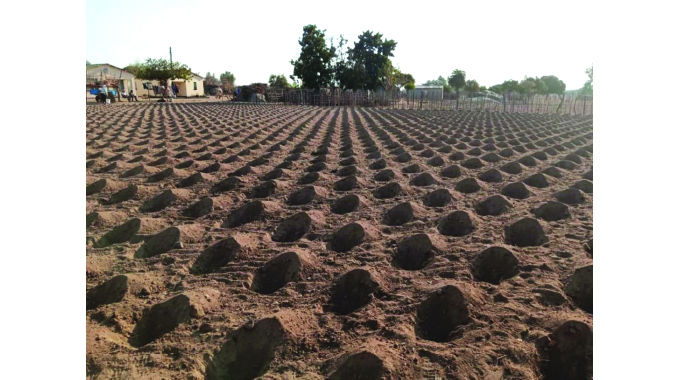
Edgar Vhera Agriculture Specialist Writer
GOVERNMENT has urged farmers to expedite the digging of planting holes under the Pfumvudza/Intwasa practice and beat the October 31 deadline set for the start of input distribution on the backdrop of plans to cover 9, 5 million plots under the programme in the forthcoming 2023/24 cropping season.
Newly appointed permanent secretary for the Ministry of Lands, Agriculture, Fisheries, Water and Rural Development Professor Obert Jiri revealed this yesterday soon after the announcement of parastatals’ board members by his boss and Minister Dr Anxious Masuka.
“To counteract the negative effects of the forecast El Nino weather pattern, Government wants all three million Pfumvudza/Intwasa beneficiaries in rural areas to do a minimum of three plots while their urban counterparts must have at least one plot. This will result in the country establishing 9, 5 million plots on an equivalent area of 400 000 hectares for grain production,” Prof Jiri said.
The Agricultural and Rural Development Advisory Service (ARDAS) weekly report dated October 2 shows that farmers had prepared 668 817 plots with an equivalent area of 38 270 hectares.
Government recently announced that only farmers who would have completed potholing three plots by October 31 would have access to Pfumvudza/Intwasa inputs, which triggered an 84 percent increase in plots done within three days from 668 817 to 1 229 588 by October 5.
Prof Jiri said due to the high productivity under Pfumvudza plots that was witnessed over the past years, the country’s food and nutrition security was guaranteed under this practice.
There is overwhelming evidence that the introduction of Pfumvudza/Intwasa has proved to be a successful initiative in transforming the livelihoods of communal farmers but has not totally spared these farming communities from climate hazards. In 2020/21 and 2021/22 seasons, maize average yield for the (Pfumvudza/Intwasa) was 5, 28 tonnes per hectare against the national average of 1, 39. The same pattern was repeated in the 2021/22 season where under Pfumvudza/Intwasa the average yield was 1, 40 tonnes per hectare against the national average of 0, 80.
This season’s input distribution will be according to agro-ecological region’s potential with those in agro-ecological 4 and 5 required to establish two mandatory sorghum and/or millet plots plus one mandatory sunflower plot and two optional plots comprising any of African peas or groundnuts.
Pfumvudza/Intwasa beneficiaries in regions 1 and 2 shall be provided with inputs to plant three mandatory maize fields and two plots comprising any of the following — sunflower, sorghum, pearl millet, groundnuts, African peas or sugar beans.
Agro-ecological region 3 Pfumvudza/Intwasa beneficiaries shall be provided with inputs to cover two mandatory maize plots and three plots comprising any of sunflower, sorghum, pearl millet, groundnuts, African peas or sugar beans.
Chiefs, headmen and village heads will establish Pfumvudza/Intwasa plots on 11 367 hectares.
The Government introduced climate smart agriculture in the form of the Climate Proofed Presidential Input Scheme (Pfumvudza/Intwasa) to ensure food security for communal farmers who largely lack the capacity to mitigate the effects of climate change on their own.



 Online Reporter