Online Reporter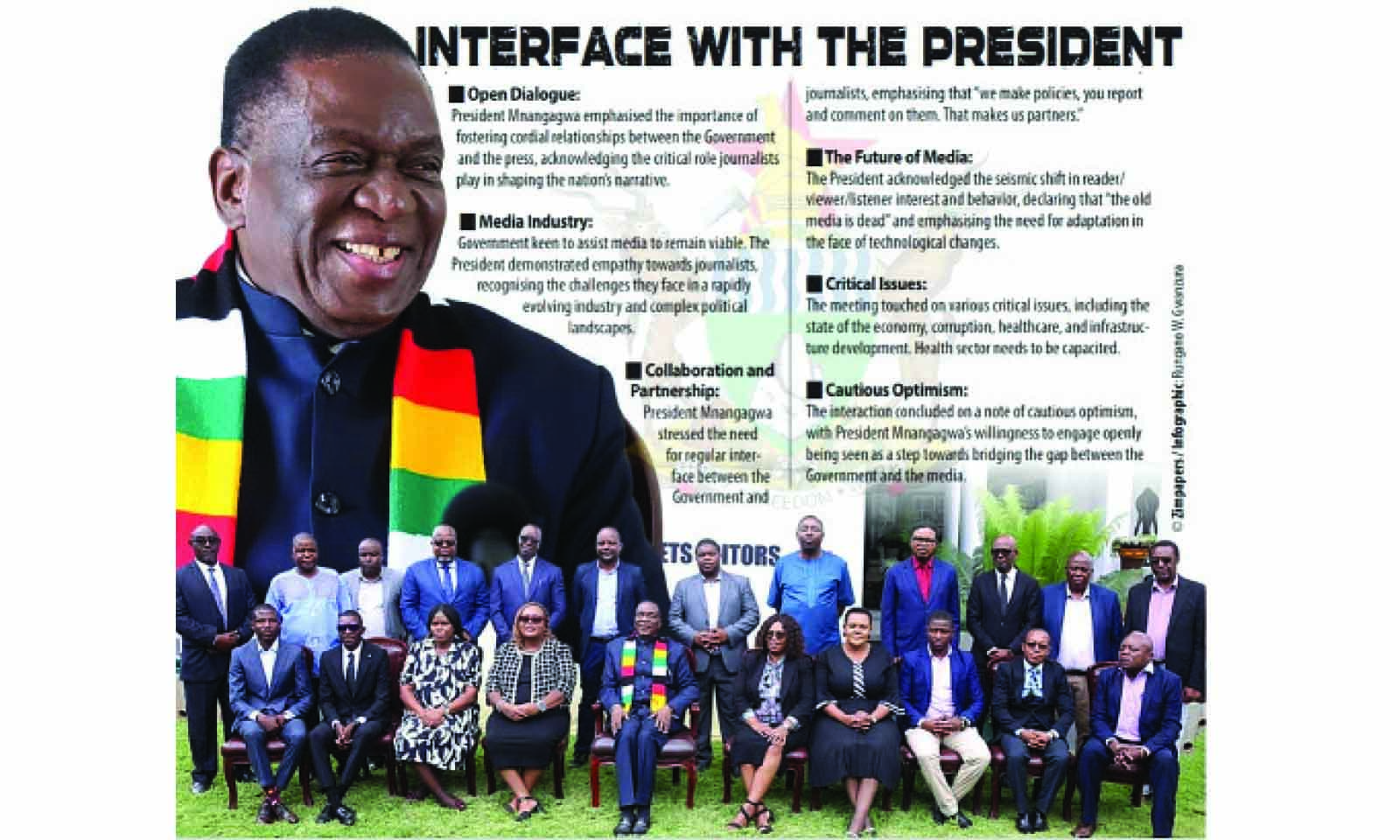
Ranga Mataire-Group Political Editor
ON a cloudy Monday morning in Harare, I found myself rushing to State House alongside a colleague.
President Mnangagwa had invited editors and senior journalists from Zimbabwe’s mainstream media for an unprecedented meeting scheduled for 9am.
I arrived a bit late, my anxiety rising as we approached the gates.
The drive from Herald House to State House is just 10 minutes, but by 9.20am we were still at the main gate, waiting for our names to be cleared.
Inside, there were many familiar faces — seasoned journalists from across the industry, seated around a long, polished table in a modest room adjacent to the President’s main office.
The atmosphere was a mix of quiet anticipation and occasional laughter.
For many in the room, this was a first: an opportunity to sit down with the Head of State and Government, the Commander-in-Chief of the Zimbabwe Defence Forces, and engage in open dialogue.
The room was full of the who’s who of Zimbabwe’s journalism.
Veterans like Reuben Barwe, Victoria Ruzvidzo, Ray Mungoshi, Chris Gumunyu and Constantine Chimakure sat alongside rising stars like Josephine Mugiyo and Takudzwa Chihambakwe.
There were colleagues I have crossed paths with over the years, united now by this rare invitation.
There was also podcaster DJ Ollah 7, whose presence reminded us that the media landscape has evolved far beyond traditional newsrooms, a fact that the President himself acknowledged in his address to us.
The Deputy Chief Secretary in the Office of the President and Cabinet (Presidential Communications), Mr George Charamba, entered with his characteristic calm authority.
“Hello, everyone,” he began, his warm smile putting us at ease.
“Just in case, (we) will go around the room and introduce ourselves — your name and your organisation.”
Mr Charamba left, only to return moments later with President Mnangagwa himself; his arrival announced with Mr Charamba’s usual robust laughter.
“Ladies and gentlemen, His Excellency, the President,” he announced.
We all rose, a gesture of respect, as President Mnangagwa entered, flanked by his Chief Secretary (Dr Martin Rushwaya) and senior aides.
The President’s presence was commanding yet approachable.
“Before we begin,” he said, scanning the room, “let’s hear from each one of you.”
His tone was warm and inviting. It set the stage for what would become a candid exchange.
Once introductions were done, the President got straight to the point.
“I told Cde Charamba that everything is on the table so that we engage and exchange in the spirit of complete openness, with nothing and no area being regarded as taboo,” he said.
What followed was a conversation that felt less like a formal address and more like a dialogue among peers.
The editors, true to the President’s pleading to leave nothing untouched, did not hold back.
He fielded questions on the topical areas of the day, including his succession, the state of the economy, the performance of his ministers, the fight against corruption, healthcare, the roads and even the Warriors.
What struck me the most was his empathy.
Here was a leader who seemed to understand the daily struggle of journalists — the pressure to stay relevant in a rapidly evolving industry; the balancing act of reporting truthfully while navigating complex political landscapes.
He emphasised the importance of fostering cordial relationships between the Government and the media, acknowledging the critical role journalists play in shaping the nation’s narrative.
“It is my wish that we meet more often in this extended way so I get to appreciate your thinking, your work and your challenges, the same way I would want to believe you are just as eager to do the same in respect of my work as an elected public servant and leader of our nation.
“Nation-building is always a collaborative project, and we all have roles to play in that binding process,” said the President.
He spoke about the seismic shift in reader/viewer/listener interest and behaviour, much of it caused, motivated or aided by giant technological changes and possibilities, declaring that the old media is dead. Even in Government, where things are supposed to be stable and traditionally change-averse, the President said they are having to adjust to fit in the ever-changing terrain.
Acknowledging both current regional and global challenges, the President said it was the duty of journalists to interpret to society all the developments.
“What that means is that you must and deserve to be well-informed in respect of the immediate world about you, so you report from knowledge and understanding, for the benefit of the reading or viewing public.” To assure the senior journalists of the Government’s sincerity in engaging them, the President emphasised the need for regular interface to share perspectives on critical matters, saying: “We make policies, you report and comment on them. That makes us partners.”
By the end of the meeting, the initial anxiety had melted away, replaced by a sense of cautious optimism.
President Mnangagwa’s willingness to engage openly felt like a step towards bridging the gap between the Government and the media.