admin
admin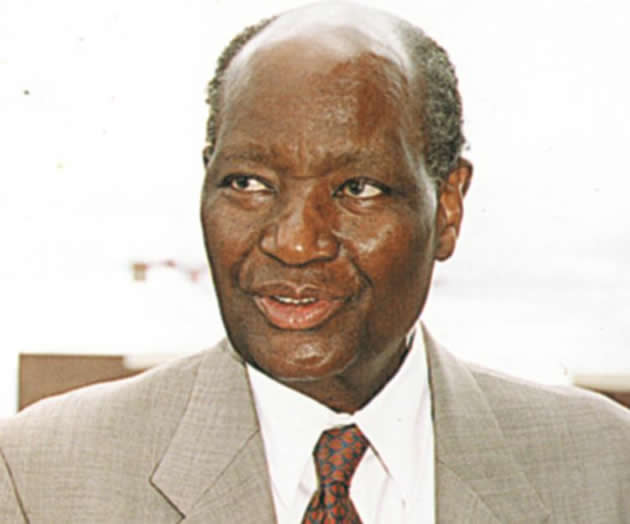
Cde Chidzero’s death came four days before the Government could bestow on him, the Order of the Zimbabwe Star for his contribution-in the nationalist struggle, his creative development reforms during Zimbabwe’s formative years, his pivotal role in spearheading the country’s economic transformation and for his distinguished stature as an international civil servant. The meritorious medal is Zimbabwe’s second highest honour. Cde Chidzero was going to be the first ever recipient of the outstanding award.
Bernard Thomas Gibson Chidzero was born at Arlington Estate, near Hatfield, in Harare. He was the eldest of seven children. Chidzero attended Jonasi-Chiremba-Mudiki Primary School in the Seke communal area. He then proceeded to Kutama Mission in Zvimba, where he completed Standard Six in 1945.
Young Bernard was a brilliant student who came top of his class year after year. On completing his studies at Kutama, he went to St Francis College, Marianhill, Natal, in South Africa for matriculation. His undergraduate studies saw him joining Pius XII University College in Lesotho for a Bachelor of Arts degree in Psychology in 1952. Cde Chidzero then left Lesotho to read for a Masters degree in Political Science at the University of Ottawa in Canada in 1955. His university studies embraced a wide field of interests, which included Economics, Sociology, Political Theory, Government, International Relations, International Law, Philosophy, Political Science and the Constitution of International Organisations. The studious Chidzero enjoyed the diversity of cultural influences and the openness of intellectual debate. While at McGill University in Montreal, he worked on a doctoral thesis, on the Influence of International Trusteeship on Tanganyika, being a study in historical perspectives of interacting forces of British colonial rule, the League of Nations and the UN and Nationalism. He received his Doctorate of Philosophy (Ph.D) in 1958. Even as he pursued his studies, Cde Chidzero found time to write and in 1957 produced his first Shona novel, the acclaimed Nzvengamutsvairo.
It was while studying in Canada that Chidzero met his future wife, Micheline Dusablon. They were married in the UK at Nuffield College, Oxford, in 1958.
In his condolence message the President and First Secretary of Zanu-PF, Cde Robert Mugabe, described the former Minister of Finance, Economic Planning and Development as a cadre who was unwavering and principled in serving both the country and the Party.
“. . . Whereas he could have very easily used educational means and high employment to escape and cloister himself from the inequities of settler colonialism, he made a personal choice to support the anti-colonial struggle in its early and troubled phase”.
This deep commitment was further seen at independence when Cde Chidzero agreed to leave his high-paying job at the UN for a modestly rewarding one as Minister of Finance, Economic Planning and Development. Today, the nation enjoys enormous social capital as a result of Dr Chidzero’s vision, which played itself out in successive budgets he proposed to the nation.
“We owe it to Bernard and cherish his contribution to the present stage of our national development where the level of education and skills amongst us is without comparison in Africa.
As I mourn his painful departure, my heart goes out to his family, especially to Mrs Chidzero, his dear wife, who steadfastly stood by her ailing husband right up to the end”, said President Mugabe.
Although Cde Chidzero lived and worked abroad he remained an active member of the nationalist struggle at home. Thus in June 1960, he joined the National Democratic Party (NDP) and was to be part of the delegation that travelled to London in 1961, to press for recognition of African interests in the new constitution for Southern Rhodesia.
At the banning of the NDP and the formation of Zapu and subsequently Zanu, Cde Chidzero maintained his loyalty and cadreship to the nationalist movements. As an academic and researcher, Cde Chidzero, working together with fellow Zimbabweans abroad, published a study entitled Economic and Social Survey of Zimbabwe: Towards a New Order. Many of the future economic programmes for the new Zimbabwe were to draw considerably from this and similar documents that sought to give vision to the new social and economic dispensation.
Zimbabwe’s independence came in April 1980. The then Prime Minister, Cde Robert Mugabe, invited Cde Chidzero to come and join the new Government.
Cde Chidzero, then Deputy Secretary-General of the United Nations Conference on Trade and Development (UNCTAD), dropped everything to come and serve his country asking only for enough time to submit his notice and return home!
Cde Chidzero was appointed to the Senate and became the country’s first Minister for Economic Planning and Development in May 1980. His Ministry swiftly moved to chart the country’s economic transformation by convening an international symposium, the Zimbabwe Conference on Reconstruction and Development (ZIMCORD) to raise funding and investment for the young nation. In revitalising the economy and making it respond to the needs of the majority, Cde Chidzero introduced a series of reforms which were designed to bring about economic and social transformation. Under Cde Chidzero, Zimbabwe’s economy moved from a command and rigid economy to a flexible and market oriented one. The one time head of UNCTAD introduced discipline in the fiscus and rationalised the use of resources. Following these reforms and innovations the country’s economy took a huge leap forward to become one of Africa’s most successful economies.
In 1988, Cde Chidzero was appointed Senior Minister of Finance, Economic Planning and Development, a post he held until his retirement from public life in April 1995. He was then appointed Special Economic Adviser to the Government up to 2001.
During his long service as a Minister in the Zimbabwean Government, Cde Chidzero proved to be one of the most eloquent and erudite members of the administration, and chaired, as Minister of Finance many Cabinet Committees. He was one of the ablest members of Parliament.
The humble beginnings of Cde Chidzero as a small village boy belied the spectacular career he was to lead as a renowned international civil servant. He campaigned in 1991 for the Office of the UN Secretary-General and came close to winning the contest. — A Guide to the Heroes Acre.


 Online Reporter