Sundaymail Editor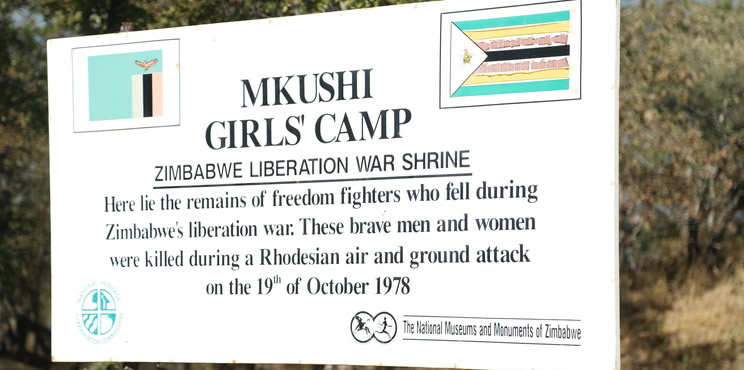
Text: Garikai Mazara ,Photography: Believe Nyakudjara, Design: Memory Gwiza
So much is written and talked about Chimoio and Nyadzonia such that one gets the impression that these were the only atrocities the Rhodesians committed.
Not much is said about Freedom Camp, Mkushi Girls’ Camp, Nampundwe, Kavalamanja or Mulungushi; refugee and military camps that were bombed by the Rhodesian army as they looked for any targets as Ian Smith realised he was losing the war.
Cde Onesmus Bhebhe, chairman of the Maqawe ‘Sizwe Entourage Trust, which was formed in 2012 and arranges annual trips to memorials scattered around Zambia, said those who died in the liberation struggle died for a united Zimbabwe and not for a particular region.
“Their dream was to see a free and united Zimbabwe. As a trust we try to teach and remind everyone, irrespective of their political standing, of the sacrifices made by those who could not make it into a liberated Zimbabwe.
“Our thrust is to teach, especially the young generation, of the path that our country travelled for it to be what it is today. When we started these tours, around 2007, we were sponsored by Government and by then we would have two full buses but as you can see today there are only 22 people in the bus.
“The tour is now personally funded; everyone who is in this bus has paid for their presence here. We contribute and the money is for fuel and accommodation. An ex-combatant, who runs a bus company in Bulawayo provides the bus and asks us to fuel it. We then provide our own food.
“And it is not like we like coming to Zambia every year, it is because we feel a part of us lies here, that a part of us didn’t go with us to independent Zimbabwe. If we don’t make these visits, it gives an impression that we have forgotten about our brothers and sisters whom we left in the bush, some of them in unmarked graves. We do these visits so that these should know, wherever they are, that we will always cherish and remember them.”
Very emotional about the issue, Cde Bhebhe continued: “We celebrated for too long, what we should have done earlier was not done, appreciating the role played by those who died and lie buried here.
“We need to pass the baton to our young generation, so that the sacrifices of those who died should not be in vain, and the young generation should know what happened during the liberation struggle. They should know that these visits have nothing to do with the politics of the day, but that we are all united in where we came from.
“The comrades who lie buried here also wanted to go to a free and independent Zimbabwe but they decided to give us their today so that we could have our tomorrow. So we should not forget them. The idea is to inherit their wish and carry it forward.”
Cde Zephaniah Moyo, whose Chimurenga name was Cde Jechoniah Zulu, was part of the 22-member group visiting Zambia last week. He survived of many attacks in Zambia including the one on Freedom Camp.
“I was attached to the security department of Zipra, which meant that I was highly trained in military issues. The moment the jets made the screeching sound on the descent to bomb us, I instinctively knew were under attack. Anyone with a military background will know what those screeching sounds of the jets mean.
“I had my pistol on me, the AK was in the car which was parked outside. I crouched, the natural position in any attack, and within minutes the office block I was in was under attack. The roof was collapsing and the walls falling as well.
“I peered through the holes that the bomb had made and saw that the bombing was concentrated on the eastern side of the camp, so I made a run westwards, away from the side that was under attack. That is why I say my survival was an act of luck than anything else. By running towards the Lusaka-Kabwe highway, I made myself an easy target for the helicopters that had joined the jets in the attack.
“Sometimes when I look back I wonder if I could have done anything else but the attack was instantaneous and there is little one could do. And from how the attack was being conducted it looked like the Rhodesians knew what and where they wanted to hit.
“They hit the parade area, just like they did at Mkushi on the same day, and at the armoury and the camp offices. The attack was brief but brutal, I think in about 25 minutes or 30 at the most, they were done and gone. But I took us that whole night and the following day, gathering the dead, taking the injured to hospital.”
Nyadzonia was hit through the collusion of Morrison Nyathi, a dissident commander in the Zanla forces. Could Freedom and Mkushi Camps have suffered from similar collusions?
Cde Moyo answered: “It is difficult to say yes or no. In military intelligence, we don’t rule out any answers. But you must appreciate that the Rhodesians were working together with the South Africans, who had far superior intelligence and equipment that we had.
“That the Rhodesians managed to attack that deep into Zambia, like at Mkushi, without being dictated by Zambia’s radar system also is telling. Maybe they flew at tree-top level, to avoid detection, or they took off from some airstrip in Zambia — those are who all possibilities. We might never find the answers but what we should — collectively — is never to forget the sacrifices made by those lying in those mass graves in and outside Zimbabwe. Their cause should not be lost on us.”
Morgan Mulalabungu, who was 16-years-old at the time of the attack, remembers the day vividly. “We were at Chombela Primary School preparing for independence celebrations. Zambia got its independence on October 24, 1964 and as had been tradition, we were going through our preparations when we saw the jets, then the bombing and were ran for cover.
“I remember most of us went into hiding well till sunset, we didn’t understand what was happening. What I remember is it was like Hiroshima, we had read about Hiroshima in our history books and the smoke that we saw billowing out of Freedom Camp on that day gave a picture of Hiroshima.
“The jets would come down and bomb, go up again and come down again. Then the helicopters came, with the white soldiers sitting by the door side, we could even see them laughing off as they were attacking.”
What made the occupants of Freedom Camp even more vulnerable was that the area had been cleared for farming purposes. One of the key strategies of the liberation was the teaching of sustainable agricultural programmes, hence people at Freedom Camp were, as a matter of that orientation, taught farming.
So the cleared land made them easy targets. Lewis Chola, a witness to the attack, said Freedom Camp was used by Samora Machel’s Frelimo fighters. “So when Mozambique gained its independence, the camp was passed onto Zapu.
“On the day of the attack, those who were trying to run away were burnt, it must have been napalm that was used. You know the way a fireman holds a hose at a raging fire, that is how those Rhodesian soldiers would burn those fleeing. I remember one group of people which had taken cover under a tree was burnt there, they were burnt together with the tree.”
When word got to Lusaka that Freedom Camp had been attacked, the Zambian government did not take long to mobilise resources and within hours ambulances were making a beeline for Freedom Camp, some 30km outside Lusaka.
“We spent the whole of that night,” recalled Cde Moyo, “picking dead bodies and ferrying the injured to hospital. The next day a caterpillar arrived from Lusaka and a mass grave was dug. This is a sad chapter of our history that we should not forget.”
Cde Bhebhe was more blunt. “We get concerned when shrines like Chimoio and Nyadzonia get better attention and funding, these freedom fighters never cared which part of Zimbabwe they came from, they died fighting for a national cause.
“So for us as a trust we find it disconcerting that the visits to Chimoio and Nyadzonia receive State funding every year yet we have to fund ourselves.”



 Online Reporter