Online Reporter
Lonster Mutata
Herald Correspondent
Zimbabwe is accelerating an irrigation-driven agricultural expansion to guarantee food security and sustain economic growth, following strong gains in production achieved under a coordinated national transformation strategy, Lands, Agriculture, Fisheries, Water and Rural Development Minister, Dr Anxious Masuka, has said.
Speaking at the Global Council of Sustainable Development Goals in Dubai recently, Dr Masuka said Government is shifting agriculture from rain-dependence to controlled production systems, with irrigation development now at the centre of national food and economic planning.
“Our clear lesson from recent years is that food security can no longer be left to rainfall patterns,” said Dr Masuka.
“We are deliberately building irrigated capacity to guarantee cereals, stabilise markets and protect the economy from climate shocks.”
Functional irrigated land has expanded from 173 000 hectares in 2020 to 237 417 hectares last year, representing the fastest growth ever recorded in the sector.
The expansion has been driven by accelerated dam construction and rehabilitation under the “dam-is-an-economy” model, which integrates water storage, irrigation, energy and agro-industrial activity.
Zimbabwe now plans to more than double irrigated area by 2030, enabling year-round production of staple cereals and industrial crops, while reducing exposure to recurrent droughts.
Dr Masuka said irrigation growth has already underpinned major gains in strategic crops, particularly wheat, which has become a critical food security buffer.
“Wheat is no longer just a commercial crop; it is now a strategic food security crop,” he said.
“During the most severe drought in 45 years, wheat production allowed us to cushion rural communities.”
Wheat output rose to 640 195 tonnes last year, exceeding national consumption requirements for soft wheat, while total production has increased by 581 percent since 2020.
Zimbabwe is now one of the few countries on the continent able to substitute wheat for staple cereals in lean seasons using domestic production.
Beyond irrigation, Dr Masuka said Government has focused on strengthening the entire food system from production to storage.
The Strategic Grain Reserve is being expanded through the rollout of modern smart silos, with national storage capacity set to double to 1,5 million tonnes, enhancing resilience against supply disruptions.
At community level, irrigation expansion has been synchronised with household productivity programmes, including the Pfumvudza/Intwasa conservation agriculture model and the scaling up of Village Business Units (VBUs).
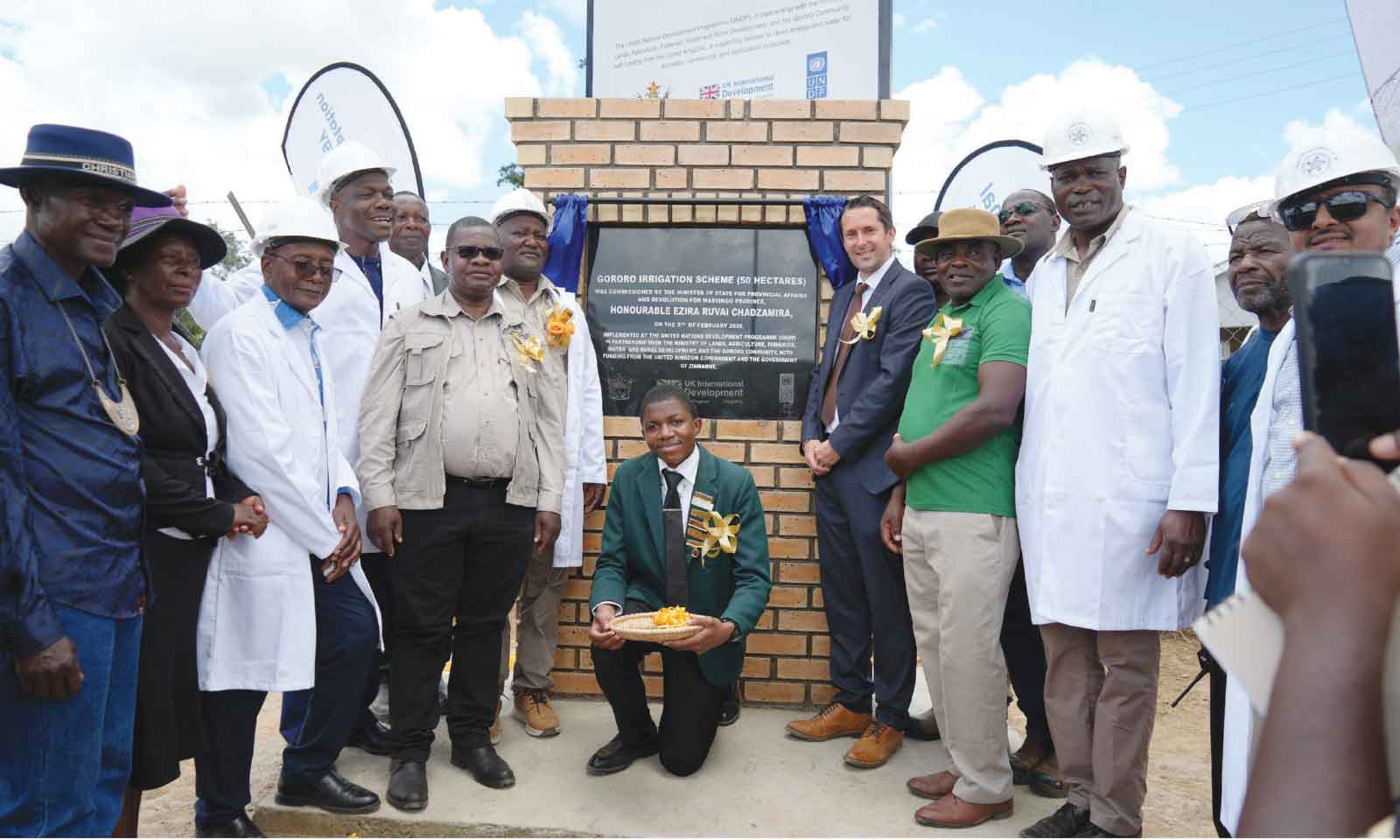
These interventions are linking water, energy, mechanisation and markets to turn subsistence farming into viable rural enterprise.
“Water without markets does not transform livelihoods,” said Dr Masuka.
“That is why irrigation, mechanisation and value chains are being developed together.”
The impact of the strategy is reflected in sector-wide growth. Agriculture gross value has increased from about US$5,2 billion in 2020 to US$10,3 billion last year with the sector contributing a significant share to national GDP growth.
Tobacco, horticulture, dairy and livestock sub-sectors have all recorded sustained production increases.
Dr Masuka said the irrigation-led approach positions agriculture as a stable anchor of economic growth, industrial development and rural incomes.
“As climate variability intensifies, irrigation is our insurance policy,” he said.
“It is the foundation upon which food sovereignty, agro-industry and national economic stability will be built.”
With large-scale irrigation expansion now firmly embedded in national planning, Zimbabwe is moving decisively towards a more predictable, resilient and market-oriented agricultural economy.