

 Online Reporter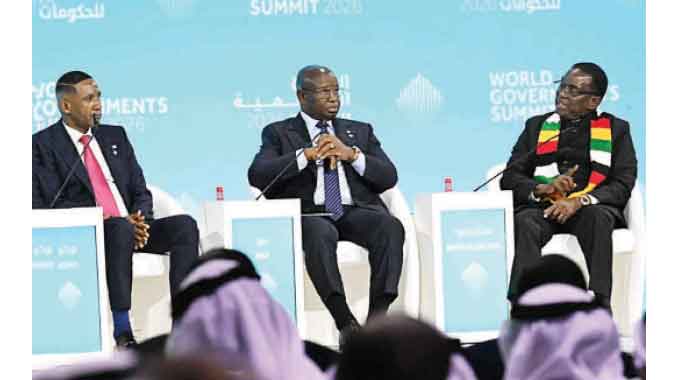
Nduduzo Tshuma in DUBAI, United Arab Emirates
ZIMBABWE is open to forging economic ties with any nation and conducts its international relations guided by what delivers the best outcomes for its people, President Mnangagwa has said.
With renewed investment interest in Zimbabwe and a peak in economic activity, the President said, despite illegal sanctions, the country has strengthened its resolve to chart its own developmental path.
Speaking during a high-level plenary session at the World Governments Summit (WGS) here facilitated by prominent American journalist Tucker Carlson, President Mnangagwa said the country moves on principles that gives best results for the country’s resources.
Titled “Is the next decade African?”, the plenary session also featured Botswana President Duma Boko and the President of Sierra Leone Julius Maada Bio.
President Mnangagwa said after Zimbabwe gained independence in 1980, most of its development thrust was from the West, but as the country evolved, it has also benefited from investment and cooperation from China and other countries.
“Zimbabwe is a sovereign State and we move on the basis that gives us the best results for our resources, whether it is in relation to the West or the East. What is primarily important is what we ourselves, as Zimbabweans, are satisfied with. We don’t need to please the West or please the East. We please ourselves,” he said.
President Mnangagwa said relations between nations are shaped by historical contexts and they evolve.
“That’s the basis on which relations grow and are nurtured. For us in Zimbabwe, yes, we are a former British colony, but we are very happy with the relations that have developed with countries like China and so on, despite being a former British colony,” he said.
The President said Zimbabwe has remained resilient and economically independent despite decades of illegal sanctions imposed by Western countries following the successful implementation of the country’s land reform programme.
“Our economy has faced challenges, I am sure you are aware Zimbabwe has been under sanctions for decades as a result of us claiming our land from the British and making ourselves independent,” he said.
“We seized the land and gave it to our people, so sanctions were imposed on us. But in spite of all that, we have developed and we are happy that we have developed on our own and we feel very independent.”
President Mnangagwa reiterated that the land reform programme was rooted in justice and historical correction, emphasising that land ownership in Zimbabwe was never based on race.
“Land did not belong to a race; it belonged to Zimbabweans, so when the colonialists took land from us, the time came when we asserted ourselves, taking back our land. Those who wanted to have land in the same places as the African people of Zimbabwe remained, but those who felt they were superior left.”
He also used his time here to pursue enhanced international engagement, investment partnerships and policy-driven cooperation with global stakeholders.
Yesterday, President Mnangagwa met representatives of Dubai-based conglomerate Jampur Group that is exploring investment opportunities in Zimbabwe’s power generation and agriculture sectors.
The Group has interests in energy, mining, heavy equipment and international trade, operating across several markets in the Middle East, Africa and Asia.
Speaking after meeting the President, Jampur chairman and chief executive officer, Mr Mohammad Shafiq, said: “We had a very good meeting with His Excellency. We discussed our intention in Zimbabwe related to the power sector, generation and transmission. We also discussed the agriculture sector and anything else that is needed in the heavy equipment area.”
He said the group is prioritising the energy sector as part of its initial entry into the Zimbabwean market, with plans to establish power generation capacity to support the country’s growing energy needs.
Among other potential investors, President Mnangagwa also held talks with DP World group chairman and chief executive officer, Mr Sultan Ahmed bin Sulayen.
DP World is a leading global logistics provider and port operator headquartered in Dubai, United Arab Emirates, managing about 10 percent of global container traffic across more than 80 countries.
Founded in 2005, the company operates at least 60 terminals, economic zones and maritime services worldwide.
The multinational specialises in end-to-end supply chain solutions, linking factories to customer doors and plays a critical role in facilitating international trade through integrated logistics, port operations and supply chain management.
President Mnangagwa returns home today after the conclusion of the three-day WGS held under the theme, “Shaping Future Governments”.


While engaging and re-engaging isn’t difficult to support, being a friend to all and an enemy to none is rather naive. It simply puts Zimbabwe in a difficult position to define its obligations as a member of a family of nations that must condemn oppression and violence against weaker states. How would Zimbabwe justify being a friend of both Israel and Palestine? And how would she manoeuvre around resolutions meant to condemn Israeli atrocities against Palestinian women and children and still remain friendly to Israel? On what basis would Zimbabwe anchor her friendship with the Zionist state? How would Zimbabwe handle her friendship with Mainland China and Taiwan? How about Israel and South Africa? Cuba and USA? Russia and Ukraine? Iran and USA? It’s not possible to be a friend to all and an enemy to none in such a polarised world. Let’s not fool ourselves. Such foreign policy is not practical. We cannot be friends with Israel while being sympathetic to the Palestinians. That’s being double faced and not good for our country.